
 By
By Do you still think that you need a traditional university degree to kickstart your career? Well, let me clear that misunderstanding for you: not every successful career requires you to complete a traditional university degree. Instead, you can explore practical alternatives, and by that I mean vocational qualifications, such as HNC and HND qualifications, which can lead you to higher salaries, skilled jobs, and even better opportunities to progress to a bachelor’s degree.
Unlike other academic qualifications that generally focus on in-depth theoretical knowledge, these require you to apply your knowledge to practical, real-world workplace situations.
Don’t worry if you don’t know what these qualifications actually mean. This isn’t rocket science, and you can easily understand it. These qualifications are designed for students like you, who want to gain industry knowledge and experience and develop practical skills in various subjects, such as engineering, business, construction, computing, and healthcare, without following a traditional academic pathway (particularly a university degree).
Here, I have explained everything you need to know about the HNC and HND, their qualification levels, what career opportunities you can take advantage of, and how these compare with university degrees. Plus, you can also get insights into which pathway can be the most suitable for you according to your academic and professional objectives.
Let’s begin this insightful conversation!
A Slight Glance into HNC and HND Meaning
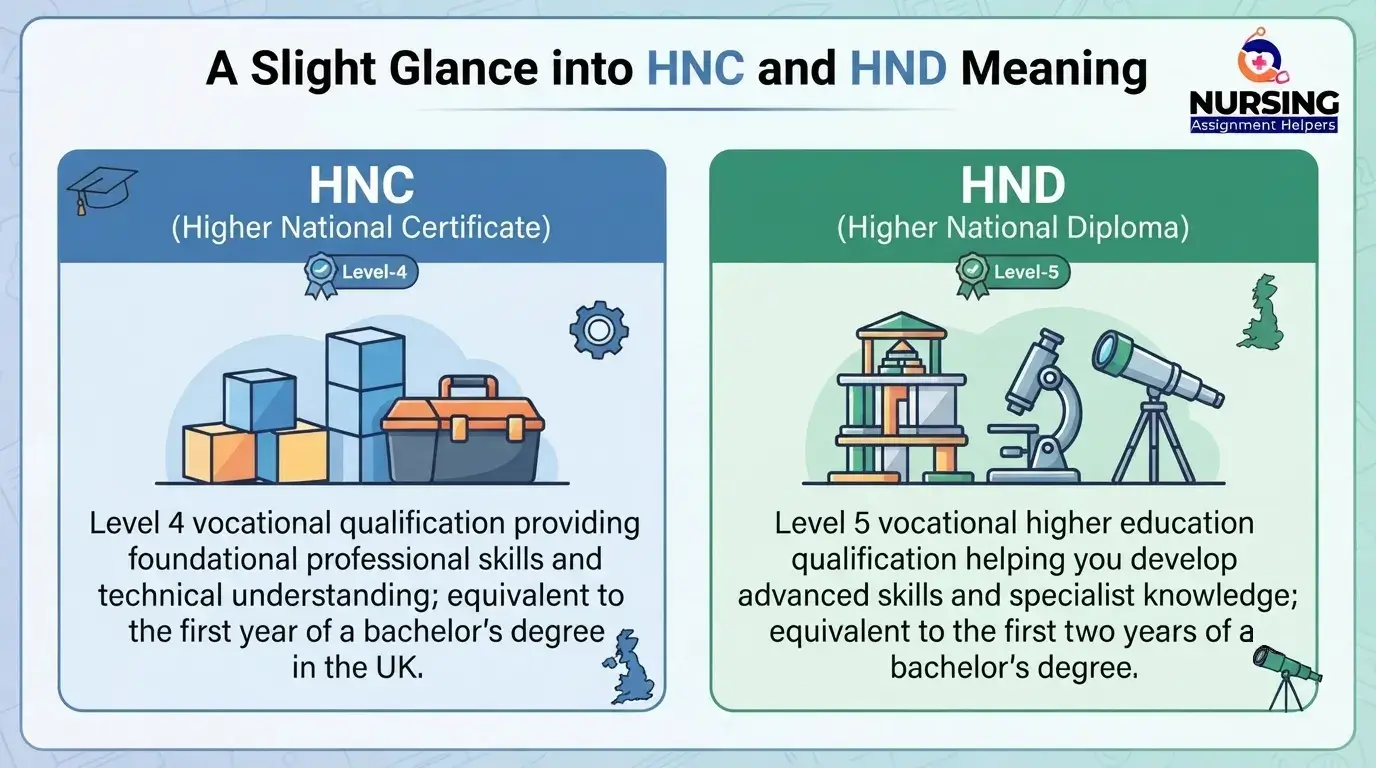
In simple words, a Higher National Certificate (HNC) is generally a Level 4 qualification that provides you with foundational professional skills and technical understanding when beginning your higher education journey. As for the Higher National Diploma (HND), it is generally a Level 5 vocational higher education qualification that helps you develop advanced skills and specialist knowledge in a specific subject scope.
If you are now thinking about ‘What is a BTEC HNC or HND?’, Business & Technology Education Council (BTEC) is the awarding body for these qualifications in the UK, which is owned by Pearson. On the other hand, an HND or HNC is a specific qualification and will be referred to as a BTEC HND or HNC when it’s awarded by Pearson.
Want a detailed breakdown? Then, keep reading!
What is an HNC Certificate or Diploma
After you have answered yourself, ‘What is HNC and HND qualification?’ with brief definitions, you might still be puzzled to find a detailed answer to ‘What is an HNC diploma?’
Since it is generally awarded as a Level 4 qualification and is completed within one year, it is equivalent to the first year of a bachelor’s degree in the UK, which helps students advance their skills and knowledge.
However, you should remember that it may take you longer to complete this certificate if you opt for part-time study.
Normally, you can apply for an HNC after completing your Level 3 qualifications, including:
- An A-Level.
- A BTEC National Diploma.
- Any other internationally recognised equivalent qualification.
You can choose your HNC programme across several subject areas, which include:
- Healthcare
- Computing
- Construction
- Creative Media
- Business
- Engineering
- Hospitality, and many other disciplines.
The Advantages
Better Opportunities to Develop Industry Knowledge and Skills
Alongside academic understanding, HNC programmes focus on helping you develop your practical abilities. Since you will be required to do industry-based assignments and projects, you can learn to provide solutions for practical workplace challenges. Therefore, it can help you build confidence before you even enter your profession.
You Can Progress to Higher Education
You must remember that completing an HNC doesn’t mean it is the end of your education. Instead, you can continue onto the HND (Higher National Diploma). Alternatively, you can also apply for a related bachelor’s degree, but keep in mind that the requirements can vary depending on the institution you choose.
You Get Better Job Opportunities
Since it is a widely accepted qualification, it can strengthen your CV and also help you boost your career and job opportunities.
Proceeding to the HND Qualification
Are you wondering, ‘What is a Higher National Diploma (HND)?’ I can help you answer your question with a detailed explanation. This is a vocational qualification, which is designed to provide you with advanced knowledge and practical skills for the workplace.
Here, you should not confuse the HND meaning because of the word ‘diploma,’ as it refers to the level and type of award you choose.
Since it will take you two years to complete this as a full-time student, you can enroll after completing your Level 3 qualifications, such as A-Levels, a BTEC qualification, or another equivalent course. That’s because it covers both Level 4 and 5 qualifications, which are equivalent to the first and second years of a bachelor’s degree.
You can usually find this qualification in professional areas, including:
- Engineering
- Healthcare
- Construction
- Creative industries
- Computing
- Accounting or Business & Management, and others.
The Advantages
Focus on Your Practical Learning
With an HND, you won’t only improve your theoretical knowledge in a particular subject, but you will also get opportunities to improve your practical learning. That’s because you will be required to work on assignments and projects that involve real-life industry situations.
Get Better Opportunities for Entry-Level Employment and Advanced Education
After completing your HND, you can explore various opportunities, whether you plan to start your career with an entry-level job or continue studying. In fact, many top-ranked universities in the UK and worldwide allow HND graduates to progress into the further stages of their related degree programme, but it may depend on the course requirements.
It’s A Globally Recognised Pathway
Moreover, these programmes are globally accepted by employers and universities in more than 60 countries, and are a great option for you to work abroad as a UK graduate or an international student.
HNC vs HND: How Do They Compare?
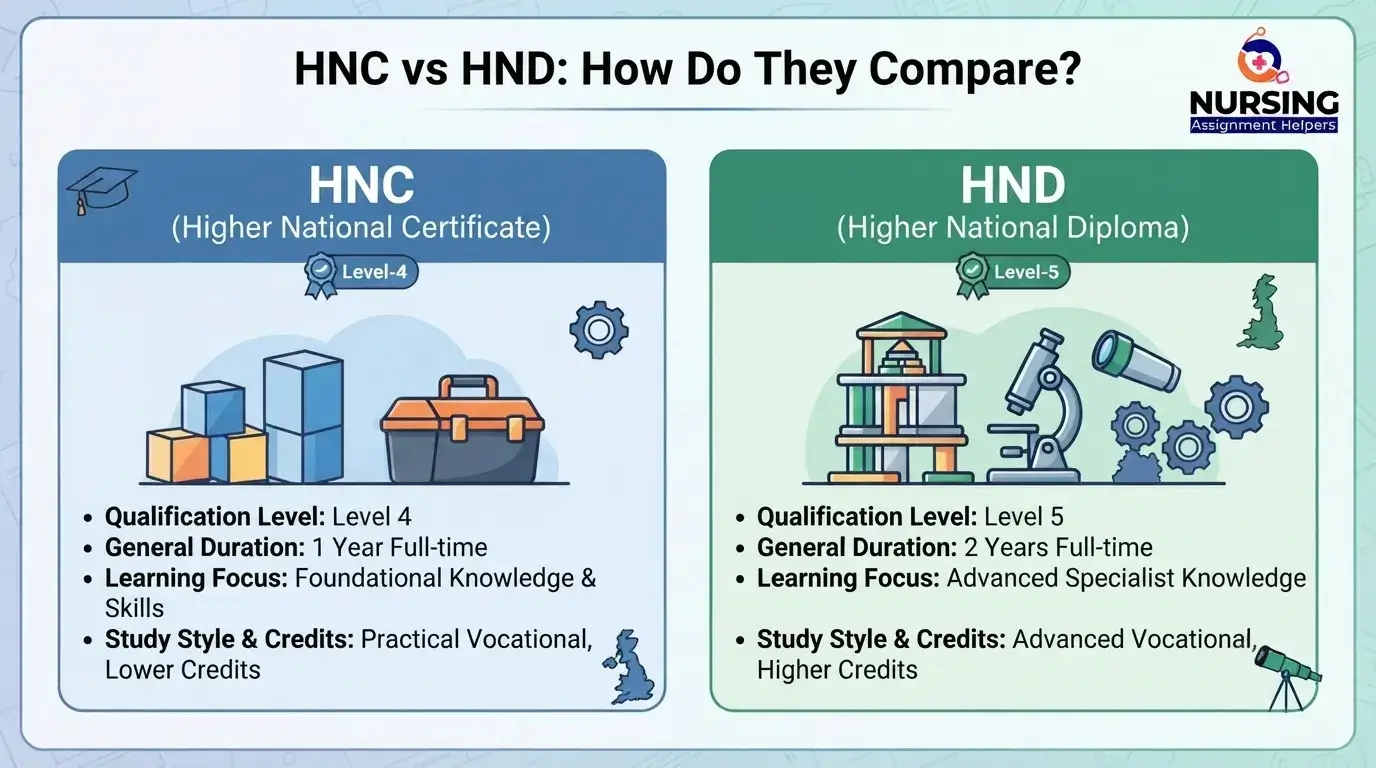
Now, the next question is, ‘What is the difference between HNC and HND qualifications in the UK?’
Here, you must understand that HNC and HND might sound similar, but remember that both qualifications represent different stages of higher education. However, don’t consider an HNC or an HND degree, as these are not full bachelor’s degrees. But these are academically equivalent to the first and second years of any university’s degree.
To help you understand, ‘What Are HNC and HND course or qualifications?’ I have explained the differences between the two by mentioning the qualification levels, different durations, study styles, and progression opportunities for the future.
| Features | HNC | HND |
|---|---|---|
| Full name | Higher National Certificate | Higher National Diploma |
| Qualification level | Level 4 | Level 5 |
| General duration | Generally, 1 year with full-time study | Generally, 2 years with full-time study |
| Entry level | You can enroll after a Level 3 qualification | You can enroll after any Level 3 qualification or an HNC |
| Learning focus | It helps you build foundational knowledge and skills | You can develop advanced specialist knowledge |
| Required credits | It requires lower credits | It requires higher credits |
| Study style | It’s a practical vocational pathway | It’s an advanced vocational pathway |
| Progress opportunities | You can proceed with an HND | You can continue with a bachelor’s degree. |
When you want to learn about the differences between these two qualifications, like most students, you might also be trying to understand which qualification can provide you with better career opportunities. Well, let me tell you that finding this answer entirely depends on your personal goals.
You can choose an HNC when you want to pursue a shorter qualification to gain essential skills that can enable you to enter your preferred industry.
On the other hand, an HND may be suitable for you when you want more advanced knowledge and to prepare for high-level roles, and even to continue your bachelor’s degree.
Understanding the Framework Levels, UCAS Points, & Course Duration
You already know that an HND Level 5 is equivalent to the first two years of a bachelor’s degree, and an HNC Level 4 is equivalent to the first year of a bachelor’s degree or any Certificate of Higher Education. Now let’s proceed to understanding the academic value of these qualifications, so you can learn where these fit within the UK’s education system.
What Levels Are HNC and HND?
HNC Level
The next question that may pop into your mind is, ‘What is an HNC classed as?’ or ‘What level is an HNC?’ Let me explain it again: it’s a Level 4 qualification in the Regulated Qualifications Framework (RQF) that mainly focuses on developing fundamental career-specific skills and is different from a traditional university degree, which follows a different study structure and purpose.
HND Level
Now, what level is an HND? Here, you should remember that it is generally considered one level above an HNC, as it is a Level 5 qualification in the Regulated Qualifications Framework (RQF) that is designed to help you gain greater expertise in your specifically chosen scope of work.
The HNC and HND UCAS Points
After learning about the basics, you must also understand: ‘What is an HNC equivalent to in UCAS points?’ I can explain that in simple words.
- At a distinction grade, an HNC is generally worth 64 UCAS points.
- Similarly, an HND usually carries 112 points at a distinction grade.
However, you must keep in mind that these UCAS points can vary depending on your overall grades.
Important to remember: Don’t get confused with UCAS points and credits. Remember that these points are mainly used when you are required to measure your A-Levels and other vocational qualifications.
What are HNC and HND Credits?
You should keep in mind that both HNC and HND qualifications use credit-based systems, which are important because they help employers and educational institutions understand the level of study you have completed.
Don’t know what credits actually are? Let me tell you that these represent the amount of learning you complete during your course.
Typically,
- You will require a few credits during an HNC, as it is a shorter qualification.
- As for an HND, it requires more credits because it covers various advanced topics.
How Long Do HNC and HND Courses Take?
Although I have already listed the durations of these qualifications in the table above, I am explaining them here as well so you don’t miss any essential details.
The Duration and Average Fees of HNC Courses
These are generally known as 1-year HNC courses because they take 1 year to complete when you study full-time, and on average, it may cost you around £4,000 to £9,250 per year as a UK student. However, you must remember that it may take you longer, around 2 years, to complete this qualification if you study part-time.
The Duration of HND Courses
Although a full HND requires you to study full-time for 2 years to complete the qualification, some students also seek 1-year HND courses. That’s because they either have already completed an HNC or have previous qualifications.
For instance, if you complete an HNC, you may be able to continue directly into the second stage of the HND programme. However, accurate durations depend on your institution, subject, and previous qualifications. On average, your HND qualification fee may range from £4,000 to £8,000 per year.
What are HNC and HND Qualifications Equivalent to in the UK?
In this section, I have explained the equivalencies so you don’t get confused while understanding ‘What is an HNC equivalent to in England and Scotland?’ I have explained here.
As you already know, HNC is academically equivalent to a Certificate of Higher Education (CertHE) or the first year of a full Bachelor’s degree in the UK; this criterion is slightly different for Scottish students. That’s because it is considered a SCQF (Scottish Credit and Qualifications Framework) Level 7 qualification in Scotland.
Meanwhile, the HND courses in London and England are equivalent to a Diploma of Higher Education (DipHE) or any Foundation degree or 1 year diploma programs in London. However, for Scotland, the SCQF considers it a Level 8 qualification.
Also, many students end up wondering, ‘Are 1- and 2-year HNC courses equivalent to a degree?’ If you have the same question, let me tell you that these are not equivalent to a full Bachelor’s degree, but you can consider them as building blocks for your higher education.
Common Entry Routes for Applying to an HND or an HNC?
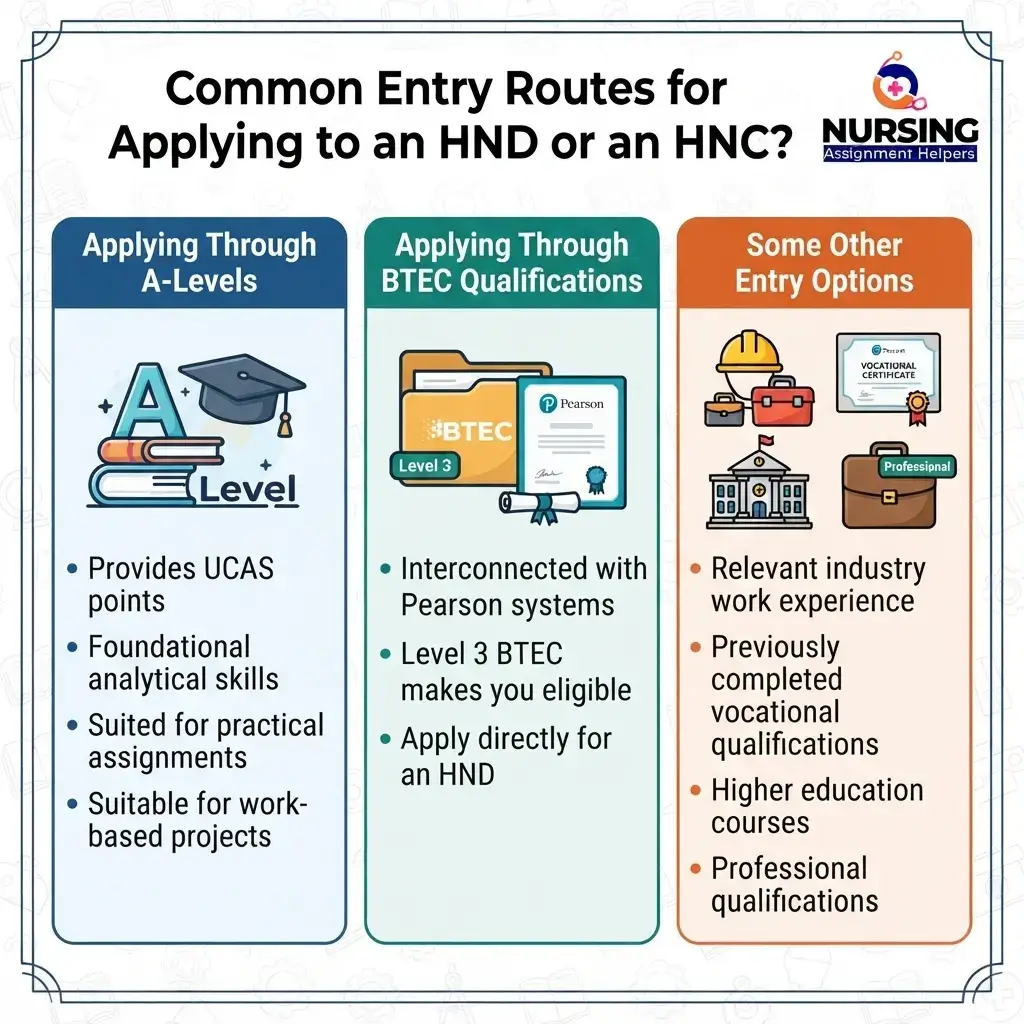
The best thing about these qualifications is the feasibility of different entry routes. Sounds convenient and stress-free, right?
What I mean is, unlike other university courses that require meeting strict academic standards, you can apply with different educational backgrounds.
Applying Through A-Levels
For instance, if you have completed your A-Levels, it can provide you with UCAS points and foundational analytical skills that are generally required for an HNC or an HND. Also, choosing either of these qualifications after your A-Levels is best suited if you prefer exams, practical assignments, and work-based projects.
Applying Through BTEC Qualifications
As you already know, HND and BTEC systems are interconnected since both are regulated by Pearson in the UK. So, you can apply for HNC and HND qualifications with BTEC qualifications, but it depends on the level of the BTEC you hold.
For instance, if you have a Level 3 BTEC, you are eligible to apply for an HND.
Some Other Entry Options
Although you should remember that entry requirements vary depending on your subject and institution, you can also enter HNC or HND courses if you have:
- Relevant work experience in the specific industry you want to study.
- Previously completed vocational qualifications.
- Higher Education courses
- Professional qualifications.
What Is an HNC and HND Equivalent To Internationally?
If you consider pursuing higher education or progressing abroad, you must understand what these UK qualifications are generally equivalent to in other countries across the globe.
What Are HNC and HND Equivalent to in America?
When you do an HNC in the United States, it is generally equivalent to completing your first year of college, which is one year of a Bachelor’s degree.
As for HND, it is usually considered equivalent to studying the first two years of a Bachelor’s or an Associate degree.
You must remember that its credits can vary depending on your specific area of study.
What Are HNC and HND Equivalent to in Australia
Are you planning to study an HND or an HNC in Australia? Then, you should know that an HNC is generally equivalent to a Diploma, which is an AQF Level 5.
Whereas an HND is typically equivalent to AQF Level 6 in Australia, which is usually an Advanced Diploma or an Associate Degree.
What Are HNC and HND Equivalent to in Canada
If you are thinking that an HNC or an HND would be equivalent to some of the 2-year post-graduate diploma programs in Canada, let me clarify that an HND is generally comparable to a 2-year college diploma.
While an HNC is usually considered equivalent to the first year of a university undergraduate programme or a 1-year college certificate.
Important note: You should remember that these requirements and rules may vary between institutions. Therefore, you must check your specific institution.
Some of the Popular HNC And HND Subject Pathways

Like other students across the UK and worldwide, you can also choose to enroll in an HNC or an HNC in business and finance, engineering and healthcare technologies, construction, and the built environment, and many other subject areas.
HNC or HND in Business and Management
Here, you should also understand that both HNC and HND qualifications in this subject usually feature the same foundational subjects, comparable to a 6-month or 1-year diploma in business management.
Whether it’s an HNC or an HND, you can understand workplace operations, how authorities make decisions in workplace environments, and improve your knowledge in important business areas, including:
- Business Management.
- Accounting and Finance.
- Marketing.
- Human Resource Management.
- Entrepreneurship and Small Business Management.
- Operations and Project Management.
If you are confused about what level an HNC in accounting, business, and finance is, it will remain the same. That means it is still a Level 4 qualification according to the UK’s RQF standards.
HNC and HND in Engineering
When you are exploring HNC and HND engineering courses, you can opt for an HNC in electrical engineering or even an HNC or an HND in mechanical engineering. Alternatively, you can also choose other specific subjects, including:
- General Engineering.
- Electronic Engineering.
- Structural and Civil Engineering.
- Computer or Software Engineering.
HND or HNC in Construction and the Built Environment
Do you want to begin your career or advanced education in Construction and the Built Environment with an HNC or an HND? These are the popular subject pathways:
- Construction Management.
- Civil Engineering.
- Architectural Technology.
- Building Services Engineering.
- Modern Methods of Construction.
If you don’t have an interest in these subjects, you can also do an HND in Quantity Surveying or an HNC in Building Surveying for a different career approach.
Not only that, but if you are a healthcare student and want to pursue telehealth nursing in the UK, you can begin with an HNC or an HND.
FAQs
Is an HND a bachelor’s degree?
No, an HND is not a bachelor’s degree, but it is a globally recognised higher education qualification that you can use as a pathway towards completing your degree.
What is the difference between HNC and HND in the UK?
In the United Kingdom, an HND (Higher National Diploma) requires two years of full-time study and is a Level 5 vocational qualification, which is mostly equivalent to the second year of a degree. On the other hand, an HNC (Higher National Certificate) is a Level 4 vocational qualification, and takes one year of full-time study, which is usually equivalent to the first year of a university degree.
What entry requirements do I have to fulfill for an HNC or an HND in the UK?
If you want to secure a spot in an HND or HNC in the UK, you typically need around one to two A-levels or an equivalent Level 3 qualification, Scottish Highers (SCQF Level 6 qualifications), or a BTEC. along with UCAS points, depending on your selected institution.
Is an HNC or HND qualification worth it outside of the UK?
Yes, these widely recognised qualifications can be worthwhile for your further education goals if you plan to study abroad. However, you must remember that the exact comparison depends significantly on your chosen country and the specific institution you prefer.
Can I switch from an HNC to an HND?
Yes, you can move from an HNC to an HND, as many HNC programmes are usually planned to help students easily progress to the second year of a related HND course. That means you will be able to use what you already know without going over the same topics again.
How should I choose between HNC and HND?
It’s very simple to decide between enrolling in HNC and HND. You can choose an HNC when you are looking for a 1-year, Level 4 qualification to begin your entry-level job. Alternatively, you can opt for an HND if you want to study a broader, Level 5 qualification for 2 years.
How do I know which one is better, HNC or HND?
You must understand that neither of these qualifications can be categorised as ‘better.’ That’s because the right choice depends on the career path you have decided on, your available timeframe, and you must also consider whether you want to do a shorter course or opt for a more advanced qualification.
What are HNC and HND equivalent to in America?
If you want to pursue a Higher National Diploma (HND) in the USA, it is equivalent to completing the first two years of a bachelor’s degree or an Associate Degree. As for a Higher National Certificate (HNC), USA universities generally consider it equivalent to completing the first year of a bachelor’s degree or even a Certificate of Higher Education.
Bringing Everything Together
When you clearly understand what both HNC and HND qualifications are, you can easily choose between them, but you must remember that the most suitable option depends on how you prefer to learn, how quickly you want to start progressing your career, and your further education goals.
However, before you apply, I suggest that you take some time to do your research and compare the course structures, entry requirements, and even the further education opportunities offered by worldwide universities for both qualifications. It can be a great way for you to make a well-informed decision, develop the right skills, and gain the qualifications you need to pursue your higher education and professional goals.
Good luck with your future academic and professional journey!