 By
By If you have ever thought I could have handled that challenging situation better, or you have made quick decisions in the middle of a problem without realising how you reached them, then these are some examples of reflection in practice. It promotes learning, growth, and analysis of the actions and decisions arising from them.
Such reflection is central to Schon’s reflective model. This model doesn’t just include reflection on action after the event but also includes reflection during the event. Furthermore, in such a fast-paced world, employers prefer individuals who can evaluate their experiences, learn from mistakes, and improve their performance. Whether you are a student crafting reflective assignments, a teacher managing a classroom, a healthcare professional making critical decisions, or an HR manager resolving conflict, reflective practice is a crucial skill.
Donald Schön developed this reflective model, and it has transformed the way professionals think about learning. Moreover, this model not only applies to classroom learning but also to professional work. It encourages professionals to become lifelong learners and reflect during and after experiences.
If you want to know everything about Schön’s reflective model in detail, then this blog is for you.
What is Schön’s Reflective Model?
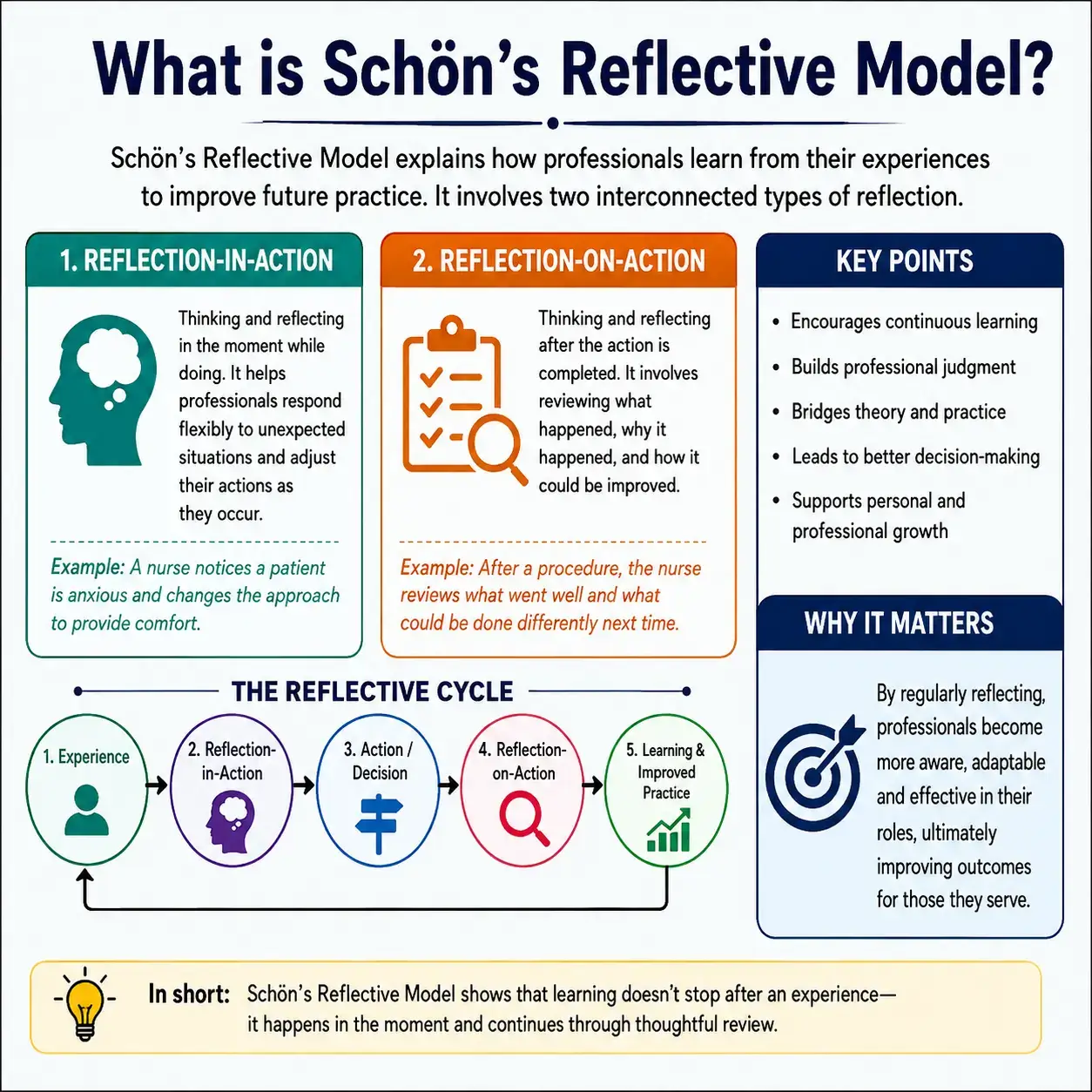
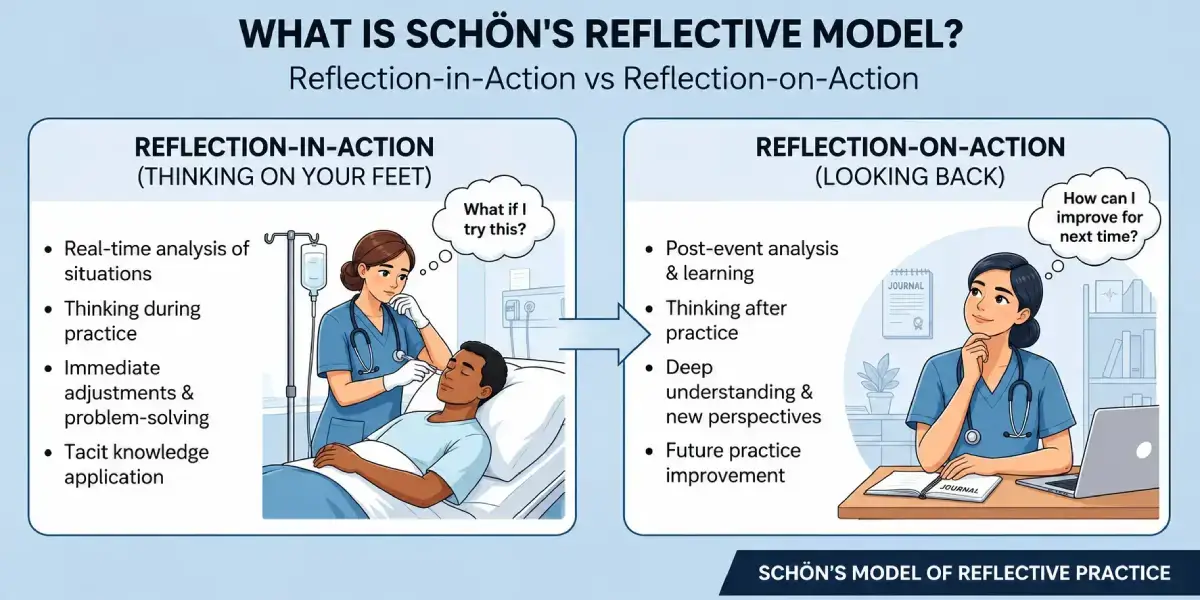
Schön’s reflective model is a professional learning framework developed by Donald Schön that focuses on the importance of reflection in learning and actions. Moreover, it moves beyond formal education and covers how professionals learn from experience during and after complex and challenging situations.
Furthermore, this model focuses on forms of reflection: reflection in action(thinking while doing) and reflection on action (thinking after doing).
It helps individuals analyse their decisions, improve problem-solving skills, and helps individuals adapt to changing situations.
Also, this model is dynamic and flexible and recognises that real-life situations can be unpredictable and require individuals to think critically and also learn from past experiences.
This model is widely used in various fields:
- Education
- Nursing
- Human resource management
- Business leadership
- Social work
- Engineering
- Psychology
It promotes continuous learning instead of one-time learning.
Background of the Schön Reflective Model: Why His Approach Revolutionised How Professionals Look at their Work?
Donald Schön was an American philosopher and MIT professor. He was always interested in knowing how professionals solved complex problems that couldn’t be solved using the standard procedures or theoretical knowledge.
He developed and published the Schön reflective model in the 1980s in his book “The Reflective Practitioner: How Professionals Think in Action ” (1983).
He revolutionised professional learning. He did this by challenging the idea of traditional education that prioritised theoretical knowledge and practical application over reflective practice.
Moreover, before Schön’s work, the model of professional knowledge was technical rationality. It was the idea that professional competence is applying theoretical knowledge to solve clearly defined problems.
However, Schön’s theory focused on professionals who constantly face challenging situations where standard rules don’t apply because real-life situations are rarely predictable.
Furthermore, his approach revolutionised professional learning by introducing the concept of reflective practice, which is thinking on your feet while performing a task and learning by analysing past experiences.
For example: an HR professional resolving an employee conflict cannot rely on the employee policies alone. Every situation is different from the previous one.
Components of Schön’s reflective Model:
Schön’s reflective model focuses on learning through experience by evaluating and analysing them as they unfold and after they occur: It comprises 4 main components:
- Problem framing: it is the first major step of Schön’s reflective model. It involves stepping back from rushing to a solution to recognise and define the exact challenge.
- Action: once you have analysed the challenge and the problem, an action plan must be created. It involves applying your skills, making real-time decisions, and trying solutions.
- Reflection: it is the main part of the model and comprises reflection in action and reflection on action. Reflection in action involves analysing and adapting to a situation while performing a task, whereas reflection on action is thinking about an experience after it has happened to evaluate your decisions and outcomes.
- Reframing: the insights from the reflection are used to modify your initial understanding. It helps develop improved strategies for new situations.
Different Types of Reflection by Schön: In Action and on Action.
There are two types of reflection by Schön: reflection in action and reflection on action. They are not isolated from each other; instead, they complement one another.
What is Reflection in Action?
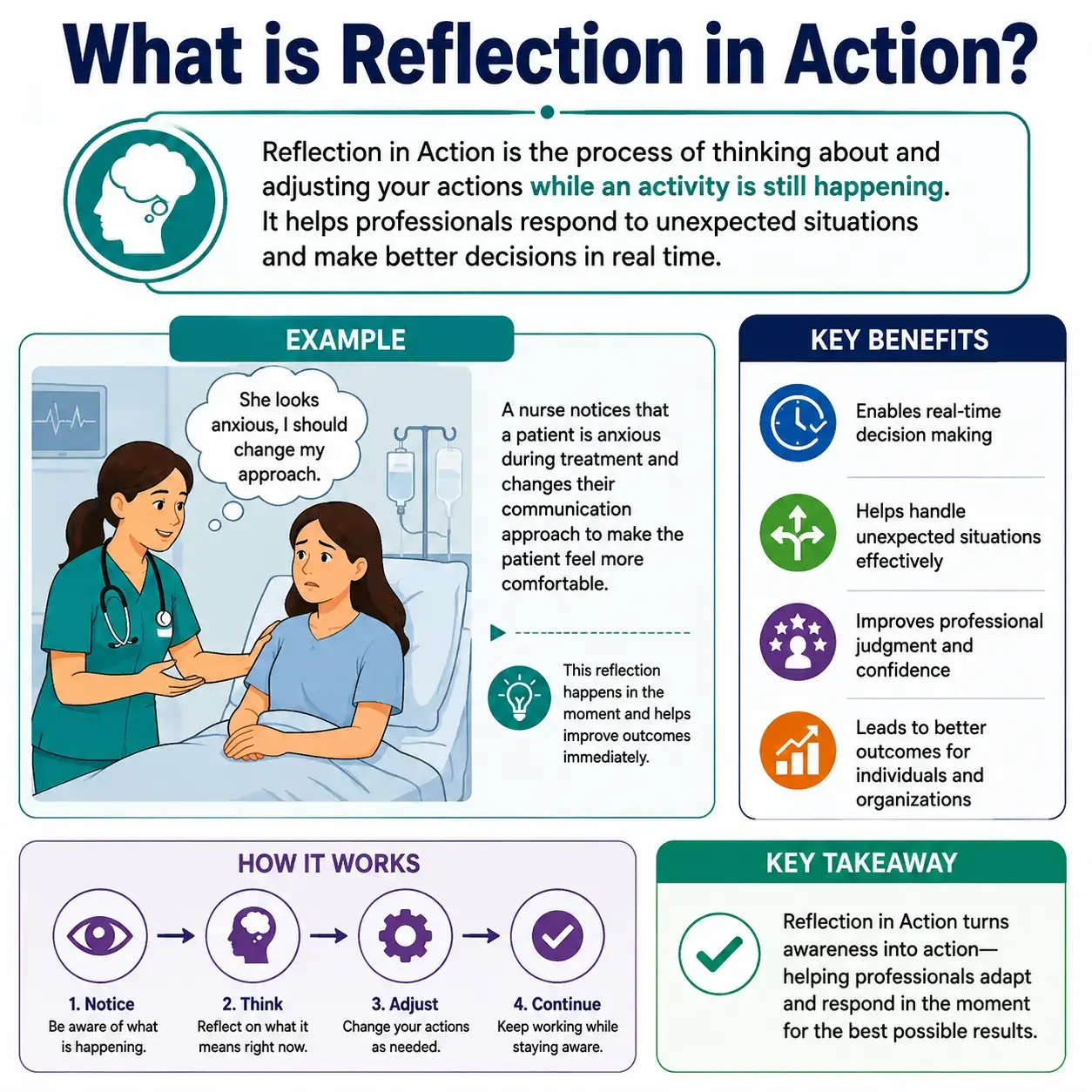
Reflection in action involves thinking and analysing actions and their consequences in the middle of a situation to make adjustments immediately. It is described as thinking on your feet.
- Occurs during an activity
- Leads to immediate adjustment
- Supports quick decision-making
- improved adaptability
- Relies on professional judgment and experience.
Example: a university professor is teaching different types of research methods. However, all the students are confused regarding the lesson. So the teacher stops in the middle of the lecture, asks questions, simplifies the explanation, and also provides critical examples.
Without stopping the entire lecture, the professor reflected in the situation and changed the teaching strategy.
What is Reflection on Action?
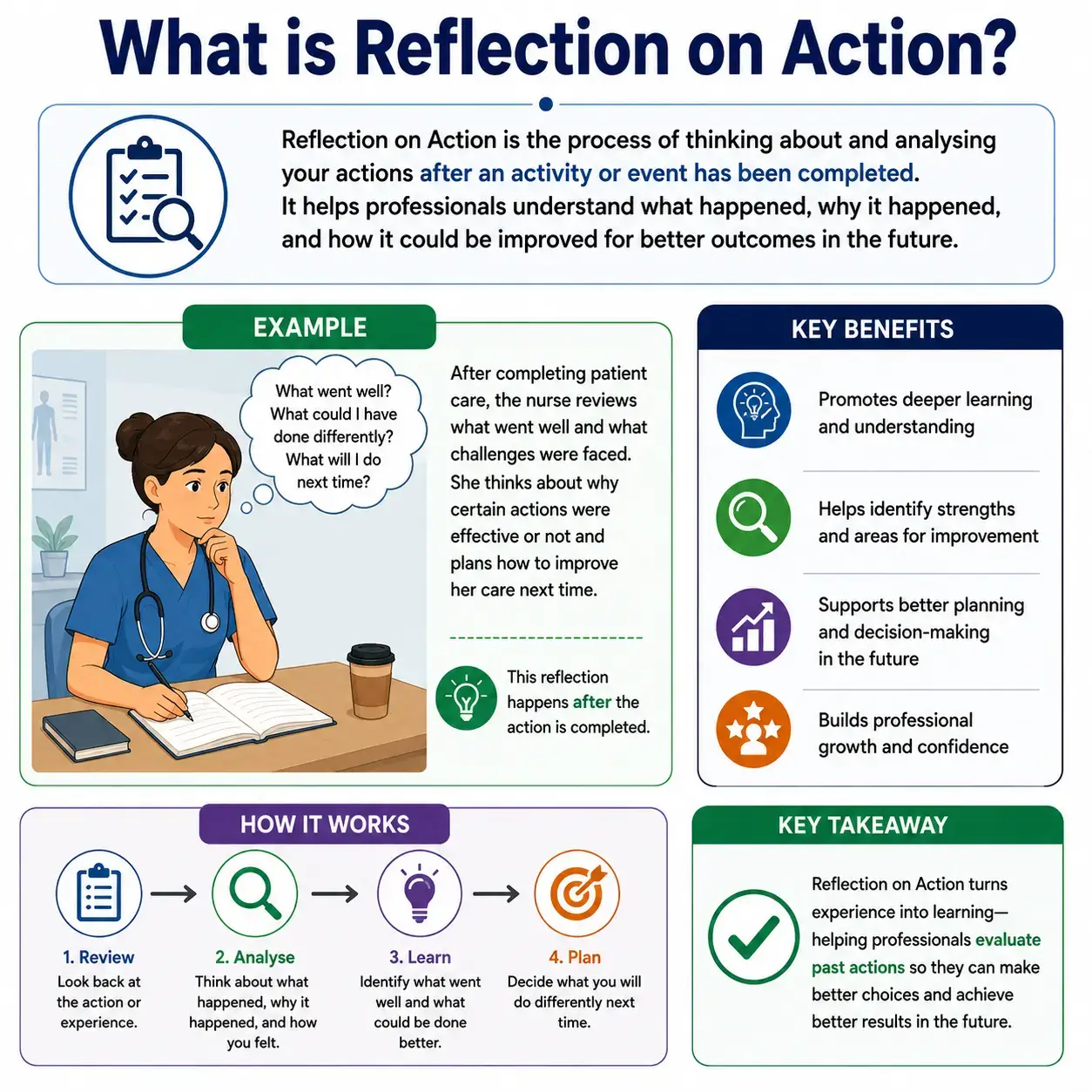
Reflection on action occurs after the situation when you look at and analyse your past experience: what happened, why it happened, and what you can learn from it for the future.
- Occurs after completing an activity.
- Involves deeper analysis and improvement areas.
- Helps identify patterns
- Improves long-term professional growth
- Supports continuous learning
What are Some Questions to Ask During Reflection on Action:
- What happened during the situation?
- Why did events unfold in that way?
- Which decisions were effective?
- What challenges did I encounter?
- How did my actions affect results?
- What would I do differently next time?
- What session can I apply in future situations?
These questions can transform any experience into professional knowledge.
Example of reflection on action:
Imagine you are an HR manager. You completed a recruitment campaign and hired 2 qualified candidates, but you took too much time.
After the recruitment, you will review each stage and realise that interview scheduling caused unnecessary delays. Then you decide to implement an online scheduling system for future hiring rounds to streamline communication. This evaluation occurred after the event.
The most effective professionals use both models simultaneously as they think critically while working and continue learning even after the task is complete
A Comparison of Reflection in Action vs On Action:
Understanding the difference between reflection in action and reflection on action is crucial to know when and how to apply each type of reflection.
| Feature | Reflection in Action | Reflection on Action |
|---|---|---|
| Timing | During the activity | After the activity |
| Purpose | Solving problems on the spot and adapting immediately | To analyse and learn from the completed experiences |
| Focus | Real-time decision making | Evaluating past outcomes and experiences |
| Thinking Style | Quick and Adaptive | Detailed and Analytical |
| Outcome | Immediate changes | Better future performance |
| Examples | A teacher changing a lesson in the middle of class | Teacher evaluating the lesson after class |
| Nature | Spontaneous, flexible | Deliberate, reflective, and structured |
What are the Similarities of Reflection in Action and Reflection on Action?
- They encourage continuous learning.
- They improve professional competence.
- They develop critical thinking skills
- They enhance decision-making
- They support self-awareness.
Which Type is Better?
It is really important to know that reflection in action and reflection on action are not isolated from each other. Reflection on action actually develops a knowledge base that further develops the reflection in action. The lessons and experiences you gain from reflecting on action develop capabilities and intuition you can use on the spot. Furthermore, the experiences you gain from reflection in action can assist with future reflection on action.
Moreover, reflection in action and reflection on action help an individual with continuous learning and improvements. A professional who uses both approaches becomes adaptable, confident, and effective in their roles.
What are the Advantages of Schon’s Reflective Model?
Schön’s reflective model provides a lot of advantages across various professions. No matter if you are a student, educator, healthcare worker, manager, or business leader, the reflection approaches can help with continuous improvement.
1. It Encourages Continuous Professional Development:
Schon’s model encourages continuous professional development as it includes a process of reflection while working on the task and analysing after completing the task. It leads to lifelong learning, and every professional experience becomes a new opportunity to develop new skills and improve the skills you have.
Due to these reflective models, professionals don’t view failures as mistakes but as a valuable learning experience.
2. It Improves Critical Thinking:
Reflection helps individuals to think critically about a situation. Professionals stop accepting situations at their face value and become more analytical by considering questions like why did this happen, how could you handle it differently, and what evidence supports my decision.
Over time, you will be able to judge situations better.
3. It Makes your Problem-Solving Skills Better:
As a professional, you will have to face unpredictable and unexpected situations. However, reflection in action will help you to respond and tackle the situation effectively and adapt your strategies according to the different circumstances.
4. It Increases Self-Awareness:
Reflective approaches help professionals to understand their strengths, weaknesses, values, and decision-making styles.
It leads to better communication, stronger leadership, and improved teamwork.
5. It Supports Better Decision-Making:
Every experience that you reflect on enhances your professional knowledge and competence.
Moreover, with so many learned experiences, professionals will be able to make informed decisions in the future.
6. It Promotes Adaptability:
As modern workplaces evolve rapidly, this reflective practice makes professionals more flexible as they become more comfortable in adjusting theoretical approaches when the situation changes.
7. It Bridges Theory and Practice:
Schon’s model shows that professional knowledge moves beyond textbooks.
This enables professionals to combine theoretical knowledge with practical experience. It leads to more effective decision-making.
What are the disadvantages of Schon’s reflective model?
1. Lack of Structured Steps:
It is a lot different from the Gibbs reflective cycle as it does not comprise a sequence of stages. As a result, beginners may struggle to utilise this reflective model
2. It can be Subjective:
As reflection relies on a person’s interpretation, this is always a risk of mistakes.
3. Time-Consuming:
For meaningful reflection, you need to allocate a lot of time. However, many professionals do not want to invest in reflection in their busy schedules.
4. Difficult for New Professionals:
It may be complex for new professionals to make immediate improvements, as they are not very experienced.
5. No Guaranteed Solution:
Reflection leads to better thinking. However, some situations remain complex even after reflection.
How to Use the Schön Reflective Practice Cycle?
Professionals can follow a process to utilise these reflective models:
1. Recognising the Situation:
The first step is to identify the experiences that require you to make important decisions or have unexpected challenges.
You can ask yourself what happened and why this situation is serious.
2. Reflect During the Activity:
While you are in a situation, you must pay attention to your emotions, thoughts, and observations.
You must ask yourself if your approach is working, whether you refine your strategy, and what alternative options are available.
3. Reflect After the Activity:
You must evaluate the performance too. You must consider what went well, what challenges you faced, which of your decisions were effective, and which decisions could be improved.
4. Identify the Lessons Learned:
Then you must summarise the key insights and trust you learned from the experiences.
5. Apply your Learning:
Don’t waste your reflection by not practicing it. The next time you deal with a similar situation, you must apply what you have learned from your previous experiences.
This continuous cycle of action, reflection, learning, and improvement strengthens your professional competence.
Difference Between Gibbs Reflective Cycle and Schön’s Reflection Model
Now let’s get into the differences between the Gibbs reflective cycle and Schön’s reflective cycle. As they are both reflection models, however, they differ in structure, timing, and application.
Graham Gibbs developed the Gibbs reflective cycle, and it comprises six stages that guide individuals to systematically review an experience.
On the other hand, Schon’s reflective model is more flexible and allows reflection during and after an experience.
| Gibbs reflective cycle | Schon’s reflective model | |
|---|---|---|
| Developed by | Graham gibbs | Donald schon |
| year | 1988 | 1983 |
| structure | Six structured stages | Two flexible forms of reflection |
| Focus | Reflection after an event | Reflection during and after an event. |
| Reflection style | Sequential and guided | Flexible and adaptable |
| Best for | Students and beginners | Experienced professionals |
| Main objective | Learning from past experiences | Continuous learning and real-time problem solving |
| Decision making | retrospective | Immediate and retrospective |
If you are wondering which model you should use, let me tell you that they serve different purposes. You can choose Gibbs’ reflective cycle if you need a structured framework, you are new to reflective writing, and prefer step-by-step guidance. However, you can choose Schon’s reflective model if you work in fast-paced professional environments and need to solve problems while working.
All in all!
Schon’s reflective model has changed how professionals approach learning. This has been done by demonstrating that knowledge is not only gained through formal education but through reflection in action and reflection on action. Donald Schon has provided a practical framework that helps individuals to improve while working and also continue learning even after the experience has ended.
His model is especially valuable for professionals in education, healthcare, human resources, social work and business management.
FAQs:
1. What is Schon’s reflective model?
Schon’s reflective model is a professional learning framework developed by Donald Schön that focuses on the importance of reflection in learning and actions.
2. What are the advantages of Schon’s reflective models?
Schön’s model helps individuals learn from experience, think critically, improve practice, and develop professionally through reflection during and after actions.
3. Can I use Schon’s reflective model in any field other than nursing?
Schon’s reflective model is versatile and applicable across many professions such as teaching, business management, design, engineering, and social work.
4. What is the difference between Schon’s reflection in action and reflection on action?
Schon’s reflection in action means thinking on your feet during an experience, and reflection on action means analysing an experience after it has happened and improving future practice.
5. How is Schon’s reflection different from Gibbs’ reflective cycle?
Schon’s reflection focuses on real-time adaptation and is divided into reflection in action and reflection on action. Gibbs’ reflective cycle provides a rigid, step-by-step process consisting of six distinct stages: description, feelings, evaluation, analysis, conclusion, and action plan.
6. What are the different types of reflective models?
- Gibbs’ Reflective Cycle(focusing on feelings and action plans)
- Kolb’s Experiential Learning
- Schön’s reflection-in-action
- The Driscoll
7. Why is Schon’s model of reflective practice crucial?
Schön’s model of reflective practice is crucial because it connects theory and real-world practice. It divides into reflection in action and reflection on action and allows individuals to adapt on their feet while continuously improving their performance.
8. What is reflection?
Reflection means thinking deeply, or carefully analysing your own thoughts, emotions, and past experiences.
9. Why is Schon’s reflective model important?
Schön’s reflective model is important because it shifts professional learning away from textbook application toward real-world adaptability.
10. What are the disadvantages of Schon’s reflective model?
The disadvantages of Schön’s reflective model are: lack of structure, heavy reliance on subjective memory, and impracticality for beginners.