


 info@nursingassignmenthelpers.co.uk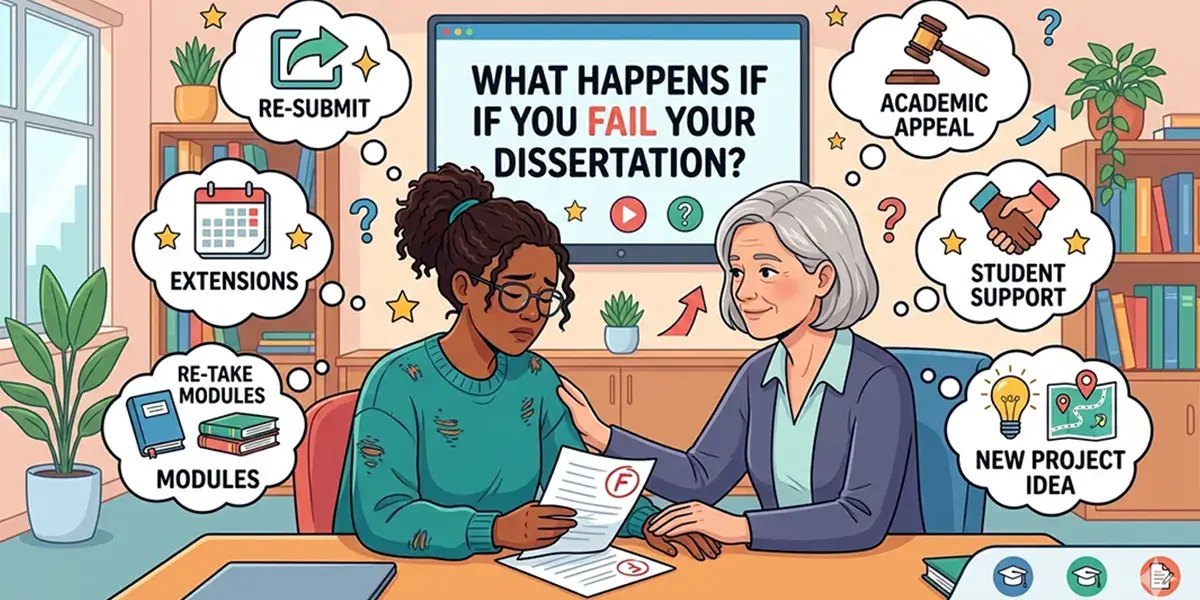
 By
By A dissertation is an important academic task for undergraduate, master’s, and PhD students. This task can be complex and challenging, and no student can avoid it.
However, when students start with their dissertation, the major question that looms over their heads is what happens if they fail their dissertation. They keep questioning each other out of fear of the consequences.
However, when starting your dissertation, such negative questions should not strike your mind because you should always start your crucial tasks with a positive and I-know-it-all mindset.
However, to pass your dissertation in one go, you need to make sure that you have a full plan, a clear strategy, and follow all the academic guidelines provided to you. This is because the primary reason students fail their dissertations is that they ignore or misunderstand the guidance provided to them.
Moreover, if you want to know everything about what happens if you fail your dissertation, then keep reading this blog.
What is a dissertation, and why is it important?
A dissertation is a lengthy and complex research project that demands strong academic writing, research, and analytical skills. It has to be submitted as part of, and as the final step of, your undergraduate or postgraduate degree.
Moreover, when you are assigned this project, you also receive comprehensive guidelines and instructions related to the structure and content of the dissertation.
The main purpose of this research project is to:
- Assess the research skills: it is a challenging project that tests the student’s ability to identify a research problem, design a methodology, and conduct a systematic investigation.
- Contributing knowledge: at the PhD level, students must contribute new knowledge to the field by identifying research gaps in the existing literature review.
- A proof of in-depth knowledge: it shows that you have specialised knowledge related to a topic within your field.
For undergraduate students, a dissertation is the task in which they have to apply the theoretical knowledge they have learned in their semesters to a real research problem. In this way, they develop skills like academic writing, research methods, data collection, and critical thinking.
For master’s students, the dissertation is more research-intensive and specialised. As a master’s student, you have to explore the topic in depth and contribute new insights within your field of study. In some cases, a strong master’s dissertation strengthens your chances of pursuing doctoral studies.
In PhD programs, a dissertation is the most significant requirement; it must be original research that contributes new knowledge to the field. It is time-consuming and may take many years to collect data, analyse it, and develop theories.
Furthermore, if you are wondering what if I fail my dissertation, then let me tell you that a dissertation has a direct impact on students’ graduation. In almost all universities, students cannot graduate until their dissertation is completed, submitted, and approved by an academic supervisor and examiners.
If your dissertation is of low quality, then it can delay graduation; if it is strong, then it may lead to academic recognition, publication, and more research opportunities.
Therefore, a dissertation plays a key role in shaping the students’ academic success and professional growth.
What happens if you fail your dissertation?
| What percentage of people fail their dissertations?
The PhD failure rate in the UK is 19.5%, with 16.2% of students leaving their PhD programme early, and 3.3% of students failing their viva. Source: discoverphds |
If you are in a situation where you have failed your dissertation, then first of all, don’t think it is the end. Fantastic news? Many universities offer resubmission opportunities, reassessment, and academic support. Therefore, it may delay your graduation, but there is a small chance you won’t receive the degree.
Resubmission:
If you have failed the dissertation, then the university may give you some time to revise, edit, and resubmit the dissertation within a specific time frame. However, the grade for the resubmitted dissertation will be limited to the minimum passing grade. This is the drawback of failing the dissertation the first time. Moreover, after failing a dissertation one time, you cannot achieve top grades, no matter how impressive your second submission is.
When you have to resubmit the dissertation, you are expected to address the feedback provided by the examiners, improve your research and writing skills, work on methodology, and strengthen your analysis.
Reassessment:
Another possibility is of reassessment, in which the revised dissertation is evaluated again by the examiners. Then, they assess whether the dissertation adheres to the academic standards required. Moreover, reassessment may involve revising some chapters, such as the methodology and discussion sections.
Grade changes:
As discussed earlier, students must be aware that the grade change will be limited to the minimum passing grade. It means no matter how much you improve your dissertation content, your grade will still be the minimum. If you want to avoid this scenario and want top grades in your nursing dissertation, then connect with nursing dissertation help UK.
Degree classification:
When you fail your dissertation, another scenario is that your degree classification could be lowered. This is because dissertations often carry significant credit weight in undergraduate, master’s, and postgraduate programs, so a failed thesis can impact your overall academic performance.
For e.g. you will have a little chance for first class or distinction classification.
What happens in Undergraduate vs Master’s Dissertation Failure?
The answer to What happens if you fail your dissertation is not simple. Depending on whether you are enrolled in an undergraduate program or a master’s program, your failure in the dissertation can have different consequences.
We all know that the academic policies are stricter at the postgraduate level than at the undergraduate level.
Undergraduate dissertation failure:
At the undergraduate level, you are supposed to complete and submit your dissertation in the final year; it contributes to the overall degree classification. Moreover, if you are wondering what happens if you fail your undergraduate dissertation, then UK universities provide reassessment and resubmission opportunities.
However, in some cases, students are also required to redo the entire dissertation or start with a new dissertation if the examiner feels the dissertation has no potential for improvement.
No matter how impressive or second submission is, your final marks will be limited to the minimum passing marks, which is around 40% in the UK grading system.
It may also affect your degree classification, as dissertations carry a high number of credits. Therefore, getting a minimum passing grade can lower your classification from a first class to a third class.
Master’s dissertation failure:
Now the question comes of what happens if you fail your master’s dissertation. The rules for the master’s dissertations are stricter than those of undergraduate dissertations. The maximum passing marks in master’s is 50%; therefore, no matter how strong your second submission, you will only get 50% marks. Furthermore, if your marks are below 40%, then reassessment and resubmission won’t be allowed to you by the UK universities. Then you will receive an exit reward, such as a post-graduate diploma instead of a complete master’s degree.
A postgraduate diploma is a short qualification equivalent to a master’s in the academic level; the only difference is that it doesn’t involve any research.
| Undergraduate dissertation | Master’s dissertation | |
|---|---|---|
| Passing marks. | Usually 40%. | Usually 50%. |
| Resubmission opportunity. | Allowed. | Allowed only for marginal failure. |
| Grade after resubmission. | Limited to the minimum passing grade. | Limited to the minimum passing grade. |
| Alternative award. | – | Postgraduate diploma. |
| Impact on degree classification. | Can lower degree classification. | Can prevent the award of MSc.(only a diploma) |
Can You Graduate Without Passing a Dissertation?
The simple answer to this question is no. If you cannot pass your final dissertation project, then it means you will not be granted a full degree. This is because it shows that you haven’t mastered the field of your study and lack research and academic writing skills.
- In the undergraduate program, a dissertation is a module that carries a large number of credits, between 30 and 40. That being said, if the dissertation is the compulsory module, then students must pass it to graduate with an honours degree. However, in the case of failure, students are granted one chance of resubmission and reassessment during the next assessment period. However, you can only get the minimum passing marks (40%). Moreover, if the student fails to pass the dissertation again, then what counts is the number of credits in the other modules. Some universities may award an ordinary degree (non-honours). With this degree, you will be a graduate but with a weaker academic classification.
- At the postgraduate level, universities consider passing a dissertation as the prerequisite for graduation. The dissertation accounts for 60 credits out of a 180-credit master’s program. Therefore, students have to earn 50% marks for a full master’s degree. However, if a Student fails to do so, then they are granted one chance to revise and resubmit. However, the final grade is limited to a minimum passing grade. Furthermore, if the student fails to pass the dissertation even after the resubmission, then they will be given an exit award, such as the postgraduate diploma or postgraduate certificate.
- At the PhD level, the dissertation is the most crucial part; you must pass it with a viva voce. However, if a dissertation is not according to the academic standards, then students will be requested by the examiners to revise and resubmit within a specified period. In some cases, a student can be awarded an MPhil. (if the work meets the level but not the PhD standard)
Can You Resit or Resubmit a Dissertation?
In the situation of failing your dissertation, you are given a second chance. Many UK universities grant a chance to students to resit and resubmit a dissertation under specific circumstances. This is because a dissertation is the core component of a degree; therefore, UK universities provide at least one chance to students for improvement.
Undergraduate resit or resubmission:
In the undergraduate program, if a student fails the dissertation once, then it doesn’t mean the end of the world, because UK universities allow students to resubmit their dissertations during the reassessment period(summer or in the next academic year).
First, you will be provided with detailed feedback on your dissertation explaining why it was not up to the mark. For some students, it may include editing only a few chapters, such as the discussion, introduction, or methodology. However, for some students, it may include rewriting the whole dissertation again.
Moreover, your revised dissertation will only be given the minimum passing grade, no matter how much effort and time you have invested. Resubmission will help you pass the module, but it will severely impact your overall degree classification.
Master’s resit or resubmission:
UK universities also provide one opportunity for resubmission and revision of the dissertation at the master’s level (in case of failing or receiving a marginal fail). The minimum passing grade for a dissertation is 50%. Moreover, if a student fails to secure 50% marks or above, then they are allowed to revise the dissertation according to the feedback received from the examiner.
In the master’s dissertation resubmission, you will be given a minimum passing grade, no matter how robust your dissertation is.
If the student fails again after resubmission, then they will not receive the full master’s degree and will be awarded with an exit qualification, such as a postgraduate diploma.
What Happens If You Fail a dissertation twice?
Failing your dissertation once has some serious consequences. Now think of the consequences of failing the dissertation twice. Typically, students are given only one resubmission opportunity after the first failure. However, in the case of failing the dissertation twice, UK universities follow some regulations, including degree downgrade, exit qualifications, or even program termination.
Undergraduate degree:
For an undergraduate student, failing the dissertation once is not the end of the world. This is because they are given a resubmission opportunity in which they consider the examiner’s feedback and revise the work. However, if a student fails again, they will not be given another opportunity to revise. In such cases, the possible outcomes are:
- Degree downgrade: if the student has completed enough credits in other modules, they can graduate but with an ordinary degree instead of an honours degree, such as BA or BSc. This degree downgrade can impact the career prospects and eligibility for postgraduate study.
- Delayed graduation: students may also have to repeat the module or their academic year. This results in delayed graduation.
- Program/termination: In the case when a student has not earned enough credits overall, the university may terminate that program.
Master’s degree:
Failing your destination twice at the master’s level means that you will not be awarded the full master’s degree.
- Exit qualifications: when a student has failed the dissertation twice, he/she may be awarded an alternative qualification, such as a postgraduate diploma or a postgraduate certificate.
- Degree downgrade: student will not receive a master’s degree, instead a lower-level postgraduate qualification.
- Program termination: In case of a student failing the dissertation twice, and all other key requirements, the university may terminate the program.
What is Dissertation Defence and Post-Defence Process?
Dissertation defence is the most important stage of the academic journey at the postgraduate level. In the UK, this process is known as the viva voce. In this stage, students have to defend their research in front of the examiners and explain their entire research, showing their topic mastery.
Dissertation defence:
During the dissertation defence, the students have to discuss and explain their research to two examiners, including one internal examiner and one external examiner. Moreover, your supervisor may attend the viva but do not take part in questioning.
The main purpose of the viva is to assess the originality and contribution of the research, the student’s knowledge about his/ her own research, the overall quality of the dissertation, and the student’s ability to defend arguments and respond to criticism.
This defence may last up to 3 hours.
What are the possible outcomes of the oral defence?
- You may pass without any correction. (when the dissertation is outclass)
- Pass with minor corrections. ( students have to make small revisions)
- Conditional pass with major revisions.
- Resubmission and reexamination.
- Award of a lower degree.
- Fail( if you are wondering whether people fail dissertation defences, then let me tell you that it’s common, especially at phd level)
Post defence process:
- Students must complete the required revisions.
- Then submit the dissertation again to the examiners.
- Once the examiner confirms that the corrections are completed satisfactorily, the University approves the dissertation.
- Students receive their complete degree.
Dissertation Grades and Difficulty
In the UK universities, dissertations are graded according to the UK academic grading system.
Dissertation grading scales:
| Percentage | Classification |
|---|---|
| 70%+ | First class distinction |
| 60%-69% | Upper second class |
| 50%-59% | Lower second class |
| 40%-49% | Third class/marginal pass |
| Below 40% | Fail |
Note: minimum passing marks for master’s is 50%.
What counts as a strong dissertation score?
A strong dissertation score falls in the 60%+ range; however, a dissertation with 70%+ is considered exceptional. If you are thinking 80% of a dissertation is good, then let me tell you that it’s outstanding. Moreover, it is not hard to get a 2.1 in your dissertation; you just need a plan and strategy for crafting your dissertation.
These dissertations meet academic standards and the examiner’s expectations.
What are the typical dissertation pass rates in UK universities?
- 85%-95% of students pass on their first attempt.
- Master’s students also pass, but most students have to resubmit it.
- PhD students’ pass rate is 80% with revision of the dissertation.
Note: Passing the dissertation is easy, but achieving good marks is difficult.
Final Advice for Students:
If you don’t want to fail the dissertation, then you must start your dissertation early and plan the process carefully. Many students face challenges when they leave major chapters at the last minute. You must break the dissertation into smaller sections, such as topic selection, research proposal, literature reviews, analysis, etc.
Also, make sure your topic is relevant and specific (not too broad, not too narrow). Another key tip is to follow the university’s guidelines.
Furthermore, you can seek your supervisor’s help at key stages, such as topic selection, methodology choice, and data analysis. Regularly communicating with the supervisor ensures that you are on the right track.
The key tip to complete your dissertation on time is effective time management. You must create a clear research timeline that sets a deadline for each chapter. You can write weekly writing goals, use productivity methods, and break the dissertation into smaller sections. It is better to complete the dissertation before the deadline so you have enough time to edit and proofread.
FAQs:
What happens if you fail your undergraduate dissertation?
If you have failed your dissertation, you will get a chance to resubmit and revise it.
Can you graduate without passing a dissertation?
No. However, in a case where you have failed your dissertation twice, you will be awarded an ordinary degree.
Can you resit a failed dissertation?
Yes, you are given at least one chance to improve your dissertation.
What is a PhD without a dissertation called?
ABD (All But Dissertation). It is a term for doctoral candidates who have finished all requirements except the final dissertation and defence.
Is 80% of a dissertation good?
Yes, it’s outstanding.
What happens if you fail the dissertation twice?
Students are granted only one resubmission opportunity after the first failure. However, in the case of failing the dissertation twice, they have to face some serious consequences, including degree downgrade, exit qualifications, or even program termination.
What happens after you defend your dissertation?
After defending the dissertation, the committee discusses your performance and final document. Then your results will be discussed with you.
What happens if you fail your dissertation uk masters?
UK universities provide one opportunity for resubmission and revision of the dissertation at the master’s level. However, you will be given the minimum passing grades, 50%.
What happens if you fail your undergraduate dissertation?
If you fail your undergraduate dissertation, then you are also given a resubmission and revision opportunity. However, your marks will be limited to the minimum passing grade.
What percentage of people fail their dissertations?
The highest rate of people failing their dissertations is at the phd level; 5%.
Can you resit a failed dissertation?
Yes, you have one revision and resubmission opportunity.
Is it hard to get a 2.1 in your dissertation?
Getting a 2:1 on a dissertation is achievable with consistent effort, solid structure, and critical analysis, but it is not considered “easy”.



 UK Cities