
 By
By Many students in the United Kingdom struggle with the critical analysis of a research paper. The reason? Lack of familiarity with its process. Students often give up when they encounter such terms in academic writing. Writing a critical analysis of a research paper is not difficult. All you need is just the clear understanding and a proper step-by-step guide. But before starting, what is the meaning of critical analysis? Critical analysis is basically the process of assessing an idea or a phenomenon. You must remember that critical analysis is not about pointing out flaws in the research; instead, it tries to understand the main purpose behind the idea or the theory. Also, it helps readers understand the meaning and context in a better way.
Do you also struggle to write a perfect critical analysis for a research paper? If this is the case, then you don’t have to worry because I’m here to guide you. Let’s dive into it!
What is Critical Analysis in Research?
We will start by understanding the main question: what is critical analysis in a research paper?
Critical analysis of a research paper is basically the systematic examination of a theory or study in order to understand its meaning and purpose. It also requires you to evaluate, deconstruct, and interpret the data, literature, and arguments. You must also ensure that your critical analysis is solely based on the evidence instead of your personal opinions. In the critical analysis, you must be able to understand and explain the “why” and “how” behind the research findings.
In addition to this, many students struggle with critical analysis. The reason? Most of them are not aware of what they are going to do in a critical analysis. Before starting your critical analysis, you must know how it differs from summarising a research paper. The key difference between a summary and a critical analysis is that a summary informs the reader about the content. But the critical analysis, on the other hand, aims to convince readers by providing:
- Evidence
- Validity
- Strength
- Methodology
Why is a Critical Analysis Important?
But the question is, why do we critically analyse research? Is it important? The answer is a big yes! Critical analysis is pretty important for a deep understanding. It also allows readers to:
- Evaluate evidence and claims
- Detect underlying prejudice
- Identify hidden assumptions
- Improve decision-making and critical thinking skills
Many students often wonder why universities require a critical analysis of a research paper. The answer is actually very simple. Universities require critical analysis to ensure a deeper understanding of concepts and theories rather than memorisation. Besides that, universities want their students to challenge assumptions, evaluate evidence, identify biases, and foster independent thoughts. These things are crucial for enhanced career growth. In simple words, universities prepare you for your professional journey.
How Does it Improve Research Understanding?
Apart from that, critical analysis of a research paper also helps to improve the understanding of the research. It helps you actively deconstruct, evaluate, and synthesise your information instead of just summarising it. The following are some ways in which it improves research understanding:
Deepens Conceptual Learning:
Critical analysis of a research paper requires more than a simple summary. Instead, it requires a deep approach to enhance the learning outcomes. Also, it allows you to connect new knowledge to existing understanding.
Identifies Research Gaps and Limitations:
Besides that, it enables researchers to identify research gaps in existing research. In addition to this, it also allows them to identify limitations in methodologies and disagreements in findings. It helps you ensure the originality of the research and boosts its credibility.
Develops Independent Arguments:
You must understand that critical analysis is way more than just summarising the research. It helps you to utilise the information and build up your own arguments and opinions. This will foster your decision-making skills.
How Critical Analysis Helps Evaluate Evidence and Arguments?
But how can critical analysis help evaluate evidence and arguments? The following are some key aspects of how critical analysis helps evaluate evidence and arguments:
Deconstructs Arguments:
First of all, it allows you to break arguments into their components, which are:
- Claim
- Evidence
- Reasoning
The critical analysis of a research paper helps you examine how these things support each other.
Assesses the Reliability of Evidence:
Besides, it also assesses the reliability of the evidence. You can do this by checking the bias and accuracy to ensure that it supports your claims.
Consider Different Perspectives:
Also, it helps you consider different perspectives across the world. It compares different opinions and opposite evidence to strengthen the overall research paper.
Step-by-Step Process to Critically Analyse a Research Paper
Now comes the main part, writing a critical analysis of a research paper. The reason why many students fail to critically analyse their research paper properly is that they don’t even know what are the 5 steps of the critical process. Are you also unaware of this process? If so, then you don’t have to worry. Let’s learn how to critically analyse step by step. The following are some crucial steps to critically analyse a research paper:
Understand the Research Question:
The very first step is to begin by understanding the research question properly. You must know the difference between several action verbs, including:
- Evaluate
- Calculate
- Formulate
- Survey
- Review
- Assess
- Examine
- Distinguish
- Investigate
- Analyse
Knowing the difference between these action verbs helps you ensure that the research paper is valid. However, if you misinterpret these questions, you might write an irrelevant critical analysis of a research paper. Hence, understanding the research paper is the first and most crucial step.
Examine the Methodology:
After that, you must analyse the methods the author used to carry out their research. To examine the methodology in a critical analysis of a research paper, you are required to assess if the following things were appropriate, ethical, and reliable for the research question:
- Research design
- Sampling
- Data collection
- Analysis technique
In this step, you must also ensure that these methods align with your study goals.
Here’s how you can examine the methodology in a critical analysis of a research paper:
Evaluate Study Design and Suitability:
First of all, you must ensure that the methodology is suitable for the research question. For that, you first need to identify whether the research question requires experimental, quasi-experimental, qualitative, quantitative, or mixed methods. You must also make sure that your methodology aligns with your study’s overall objectives.
Assess Data Collection and Sampling:
Besides that, you have to ensure that the sample size is satisfactory for the research, and your sampling technique is appropriate. Also, assess whether it introduces bias or not. You must also mention the tools and methods that you have used to collect the data. This can include:
- Surveys
- Interviews
- Lab equipment
You also need to make sure that you have used valid and reliable instruments in this step.
“80.2% students reported struggling with selecting appropriate data analysis methods for their research.” (source: Nature)
Review Analysis Methods:
You should also review your analysis methods. You need to assess whether the qualitative or quantitative analysis methods are appropriate for the type of data that you have collected.
Critically Assess the Limitations and Ethics:
Further, you also need to include the limitations of your methodology. To ensure professionalism, you must also add the ethical considerations. Tell your readers that your methodology involves confidentiality and informed consent. Also, discuss that it is approved by the Institutional Review Board (IRB). This will also help you boost the credibility of your methodology.
Identify Potential Biases:
Finally, end your methodology by identifying potential biases in the research.
Evaluate the Evidence:
For the next step, you have to examine the data. You must include your evidence in the result section in the form of:
- Direct quotations
- Statistical data
- Tables
- Figures
- Charts
In this step, you must ensure that your findings directly support the research’s claims. You also need to make sure that the data you have added is reliable. For that, it is vital to use only trustworthy and valid sources. However, many students struggle to find such sources. If this is the case for you as well, then you should seek help from professionals. For instance, if you are working on a nursing research paper, then consider seeking Nursing Dissertation Help from highly reputable services. They will provide you with highly credible sources.
Analyse Arguments:
In addition to this, you have to analyse arguments in a research paper. But how can you do that? To analyse arguments, you must identify the core claims, assess the supporting evidence, and question basic assumptions. The following are some steps to analyse arguments in a research:
- Break down the argument
- Assess the quality of evidence
- Identify assumptions and check logical validity
- Check for bias
- Consider counteragreements
You must focus on identifying how the author has presented their arguments and check whether those arguments are supported by evidence or not. Also, ensure that they have mentioned the limitations in their research. To write a high-quality critical analysis of a research paper, you must not just describe your points. Instead, critically evaluate them to prove your claims.
Assess Conclusions:
Finally, you can end your critical analysis by summarising the main findings of your critical analysis and explaining their significance in your field of study. Also, ensure that your claims are backed by reliable and credible evidence. Moreover, an important thing to add in the conclusion is whether the author answered the research question directly or not. You must also include the limitations of the research and suggest realistic ideas for future research. Always remember that you must not add any new data or information in the conclusion. Instead, just summarise what you have discussed earlier.
Have you clearly understood how to critically analyse a research paper? Let’s move on to its structure.
Structure of a Critical Analysis of a Research Paper
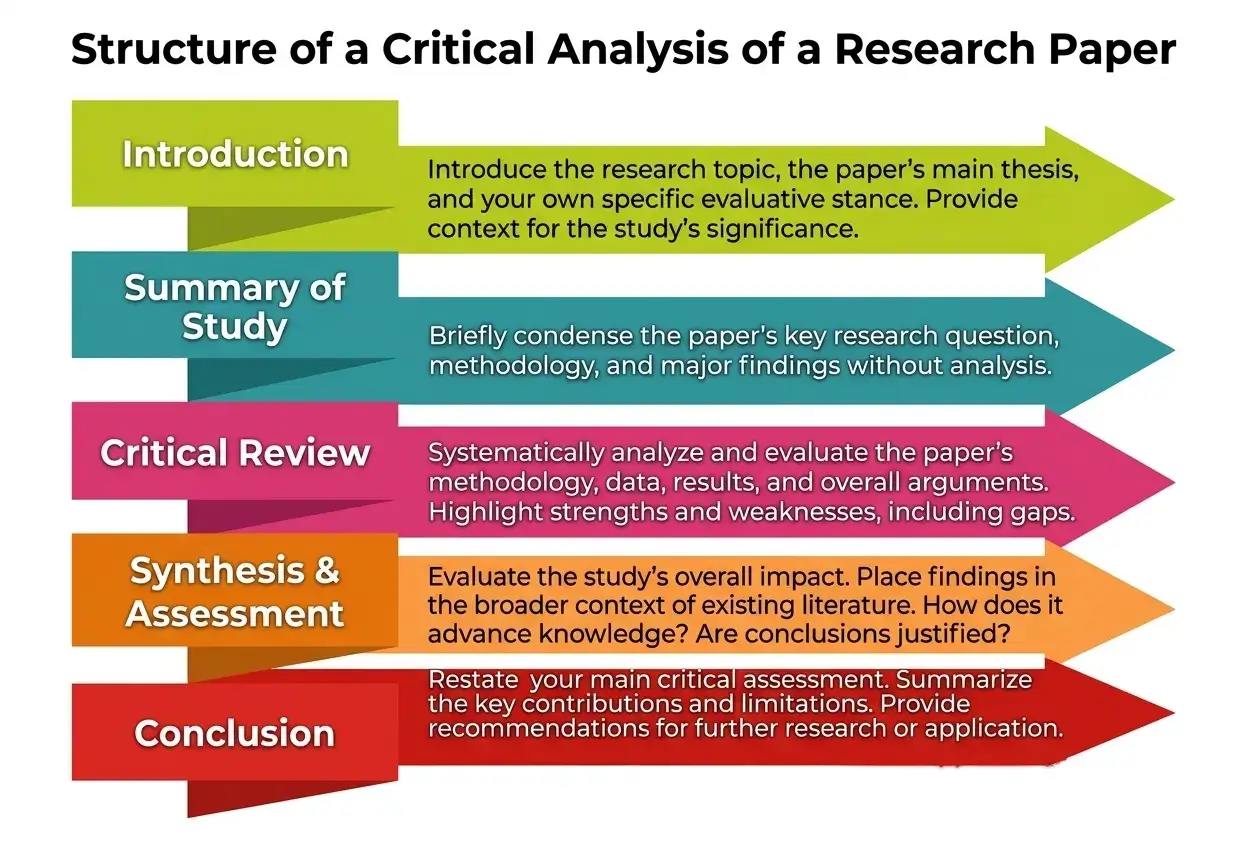
Instead of Analysis heading , write ‘Critical Evaluation’ in the heading.
Another big issue faced by students is that they don’t know what is the format of critical analysis. Due to this, they are unable to meet the high standards of their programs, which leads to their poor academic performance. In order to craft a top-notch critical analysis of a research paper, you must be aware of how it is written. For that, you must know what are the four parts of a critical analysis. This is how you should structure your critical analysis of a research paper:
Introduction:
Begin by writing a clear and engaging introduction. You must ensure that your introduction sparks the reader’s curiosity to keep them hooked to your critical analysis. In this section, you must include:
- The title of the research paper
- Author’s name
- Date of publication
Besides that, you need to give a brief outline of the main questions of the research paper, along with its objectives and arguments. You must also state your overall assessment of the effectiveness and validity of the research paper.
Summary of the Research:
In this section, you have to give a summary of the research. This means that you must summarise the key points, findings, and arguments presented by the author in the research. Ensure that you do not include your critique in this part.
Evaluation and Critique:
This is the core of your critical analysis of a research paper, which means these are the body paragraphs. In this section, you need to include:
- Methodology
- Results
- Discussion
You must use relevant and highly trusted evidence to back your critique. This will help you boost the credibility of your critical analysis.
Conclusion:
Finally, conclude everything you have discussed. You must restate your thesis or research question in your own words based on the evidence you have presented in the body paragraphs. In addition to this, clearly state the quality and significance of the research paper to your field of study. You can also provide some suggestions for future research.
Key Elements to Evaluate in a Research Paper
Now that you have a strong grasp on writing a critical analysis of a research paper, you must also know some key elements that you should examine when analysing a research paper. These elements include:
Research Objectives:
The very first component is the research objective. You must ensure that the objectives of the research paper are SMART (Specific, Measurable, Attainable, Relevant, Time-bound). Along with this, the research question must address a clear, well-defined, feasible, and unique problem.
Literature Review:
Besides that, you must conduct a comprehensive literature review to identify the gaps in the research. You must evaluate the relevance of the research in your field of study. Your literature review must be a well-written, strong piece of critique that identifies gaps in the research rather than just summarising it.
Research Design:
You must also assess that the research is appropriate for the research question. It helps you identify whether the research must be experimental, observational, or a survey.
Data Analysis:
You also have to check whether the findings directly answer the research questions or not. Also, check if the data is presented in a well-organised way (tables and figures) and whether it is appropriate and credible or not.
Conclusions and Limitations:
Finally, you must confirm that the conclusion is supported by highly credible and relevant evidence. Besides, the research must also summarise the key takeaways and include the limitations. It must also provide relevant and logical future research suggestions.
Common Mistakes in Critical Analysis
Countless students make some common mistakes in the critical analysis of a research paper. Due to this, they fail to secure impressive grades, which also affects their academic performance. To ensure that you don’t repeat the same mistakes, you must first know what those mistakes are. The following are some common mistakes repeated by students while writing a critical analysis of a research paper:
Summarising Instead of Analysing:
One of the most common mistakes in critical analysis is that the majority of students summarise the research paper rather than analysing it. As a result, their critical analysis lacks quality and credibility; hence, it becomes irrelevant.
Ignoring Research Limitations:
Many students also ignore including research limitations in the critical analysis of a research paper. This will make your critical analysis lose validity and credibility. Besides that, if you won’t add the limitations of the research, you will not be able to identity potential bias of the research. This will ultimately reduce the quality of your critical analysis.
Lacking Evidence for Criticism:
Critical analysis requires you to provide constructive criticism of the research. However, if you won’t have sufficient evidence, your critical analysis would have no authority or credibility. Due to this, your critical analysis will also fail to meet the high standards of your program, leading to unsatisfactory grades.
Focusing Only on Weaknesses:
Lastly, if you have to critically analyse an evidence-based practice in nursing research paper, you must not just focus on the weaknesses of the research. Instead, critically analyse the strength of the research. For a high-quality and credible critical analysis, you must ensure that your critical analysis is neither too critical nor too positive. Just keep it balanced.
Struggling with your nursing research paper writing? Seek help from our experts!
Do you find nursing research paper writing challenging? No worries! Nursing Assignment Writers is here to assist you with high-quality, error-free research papers.

Wrap Up!
The critical analysis of a research paper is indeed difficult, but using a reliable step-by-step guide will help you ace your analysis. Some of the crucial steps include:
- Understand the research question
- Examine the methodology
- Evaluate the evidence
- Analyse arguments
- Assess conclusions
You must also ensure to be aware of its structure to ensure that you don’t lose marks. Besides that, before starting yur critical analysis, ensure to go through some of the common mistakes repeated by students. This will help you make sure that you don’t repeat the same mistakes.
This brings us to the end of our discussion!
I hope this blog will help you write a top-quality critical analysis. Best of luck!
FAQ’s
How to critically analyse a research paper?
To critically ananlyse a research paper, you must:
- Comprehend the research question
- Check if the methodology is appropriate
- Confirm whether the data supports conclusion
- Identify potential bisases
What is critical analysis in research?
A critical analysis in research the examination and evaluation of a research in detail. Additionally, it allows you to understand the purpose, findings, and gaps of a research.
How to critically analyse step by step?
This is how you can critically analyse step by step:
- Understand the research question
- Examine the methodology
- Evaluate the evidence
- Analyse arguments
- Assess conclusions
What are the four parts of a critical analysis?
The following are the four parts of critical analysis:
- Introduction
- Summary of the research
- Evaluation and critique
- Conclusion
Why do we critically analyse research?
We critically analyse the research in order to evaluate the validity, credibility, and relevance of its findings. It also requires evidence-based decision-making to ensure that the claims are relevant and credible.
What is the format of critical analysis?
The format of the critical analysis is:
- Introduction
- Summary
- Critical evaluation
- Conclusion
What are the 5 steps of the critical process?
The 5 steps of the critical process include:
- Understanding the research question
- Examining the methodology
- Evaluating the evidence
- Analysing arguments
- Assessing conclusions
What are some common mistakes in the critical analysis?
The following are some common mistakes that students make inthe critical analysis:
- summarizing instead of analysing
- ignoring research limitations
- lacking evidence for criticism
- focusing only on weaknesses
Can you critically analyse your own research paper?
Yes, you can critically ananlyse your own research paper. It help you enhance the quality of your research paper and enhances your academic skills.
Why do universities require critical analysis of a research paper?
Universities require critical analysis of a research pape for numerous reasons, including:
- Developing strong critical thinking and analytical skills
- Enhancing your academics
- Preparing you for professional life