 By
By The United Kingdom has long been recognised as one of the world’s most influential education destinations. Furthermore, it attracts students from every continent. The reason why its universities are known is because of their academic excellence, research innovation, global employability, and centuries-old traditions that are blended with modern learning approaches.
From historic campuses to cutting-edge research facilities, the UK provides an incredible academic environment. Furthermore, these universities support intellectual growth, career development, and international exposure.
Students choose British institutions not only for their prestige. However, they also go for their flexible degree structures, industry connections, and diverse student communities. Whether you want to pursue medicine, engineering, business, or humanities, the UK offers options that are tailored to every academic and career aspiration.
However, with the list of universities in the UK, it gets challenging for students to pick the right one.
If the UK is your study destination then this blog is for you. Here we will provide a comprehensive breakdown of the list of best universities in the UK across England, Scotland, and Northern Ireland. We will also explain the Oxford college system, explore rankings and help you choose the right university based on your goals, finance and career prospects.
| According to the latest UK university rankings 2026 published by Times Higher Education, British institutions consistently rank among the top 100 globally. |
Overview of Higher Education in the UK
The UK higher education system is one of the most structured, research-driven, and internationally respected in the world. Moreover, their universities combine traditional academic excellence with modern teaching approaches to offer degrees that are globally recognised and valued by employers.
Types of Universities in the UK
The British higher education institutions fall into several categories, including:
- Research-intensive universities: These universities mostly focus on innovation, academic research, and postgraduate education. Additionally, they often receive significant research funding and global recognition.
- Public universities: Most universities in the UK are publicly funded. However, they do operate independently to maintain the high academic standards and institutional autonomy.
- Russell Group universities: Think of it as a group of 24 research-focused institutions that are known for their teaching quality, employability outcomes, and academic excellence.
- Specialist universities: These universities in the UK mostly focus on specific areas such as arts, design, business, medicine and technology.
| Did you know? Despite having just over 160 universities, the UK consistently places 4 universities in the global top 10 and around 17 in the global top 100. That means a relatively small higher education system competes directly with much larger countries like the USA and China. (UK University Rankings 2026) |
UK Degree Structure
If we talk about the structure of a UK degree, then you should know that British universities do offer shorter and more focused programs compared to those in many other countries.
- Undergraduate degrees: Typically 3 years
- Master’s degrees: Usually 1 year
- Doctoral programs: Around 3–4 years
This structure allows students to get admission in their desired program while saving time. It also reduces tuition and living costs for students.
Global Reputation & Employability
Those students who graduate from UK universities are considered highly employable as their degree is globally recognised. Furthermore, the UK is known for its:
- Practical teaching methods
- Research exposure
- Internships and placements
- Strong alumni networks
Did you know that the UK consistently ranks among the countries with the best education system in Europe? If you want to build a career, the UK is the best place to study.
List of Top Universities in England
The list of top universities in England includes some of the most prestigious institutions in the world. Furthermore, they are known for their academic excellence, leadership development, and global impact. Also, these universities consistently dominate the UK university ranks 2026 and are known for producing Nobel Prize winners, world leaders, and industry innovators.
Here is the table of the top universities in England.
| University | Location | Popular Courses | Global Ranking (2026) | Tuition Cost (International Students) |
|---|---|---|---|---|
| University of Oxford | Oxford, England | PPE, Law, Medicine, Philosophy | #1 (THE) | £26,000 – £45,000 per year (Medicine up to £45,000) |
| University of Cambridge | Cambridge, England | Engineering, Mathematics, Natural Sciences, Computer Science | Top 5 (THE) | £22,000 – £42,000 per year (Medicine up to £42,000) |
| Imperial College London | London | Engineering, Medicine, Science, Business | Top 10 (THE) | £28,000 – £41,000 per year (Medicine up to £41,000) |
| London School of Economics (LSE) | London | Economics, Politics, Social Sciences | Top 50 (THE) | £23,000 – £32,000 per year |
| University College London (UCL) | London | Medicine, Architecture, Psychology, Education | Top 25 (THE) | £22,000 – £40,000 per year (Medicine up to £40,000) |
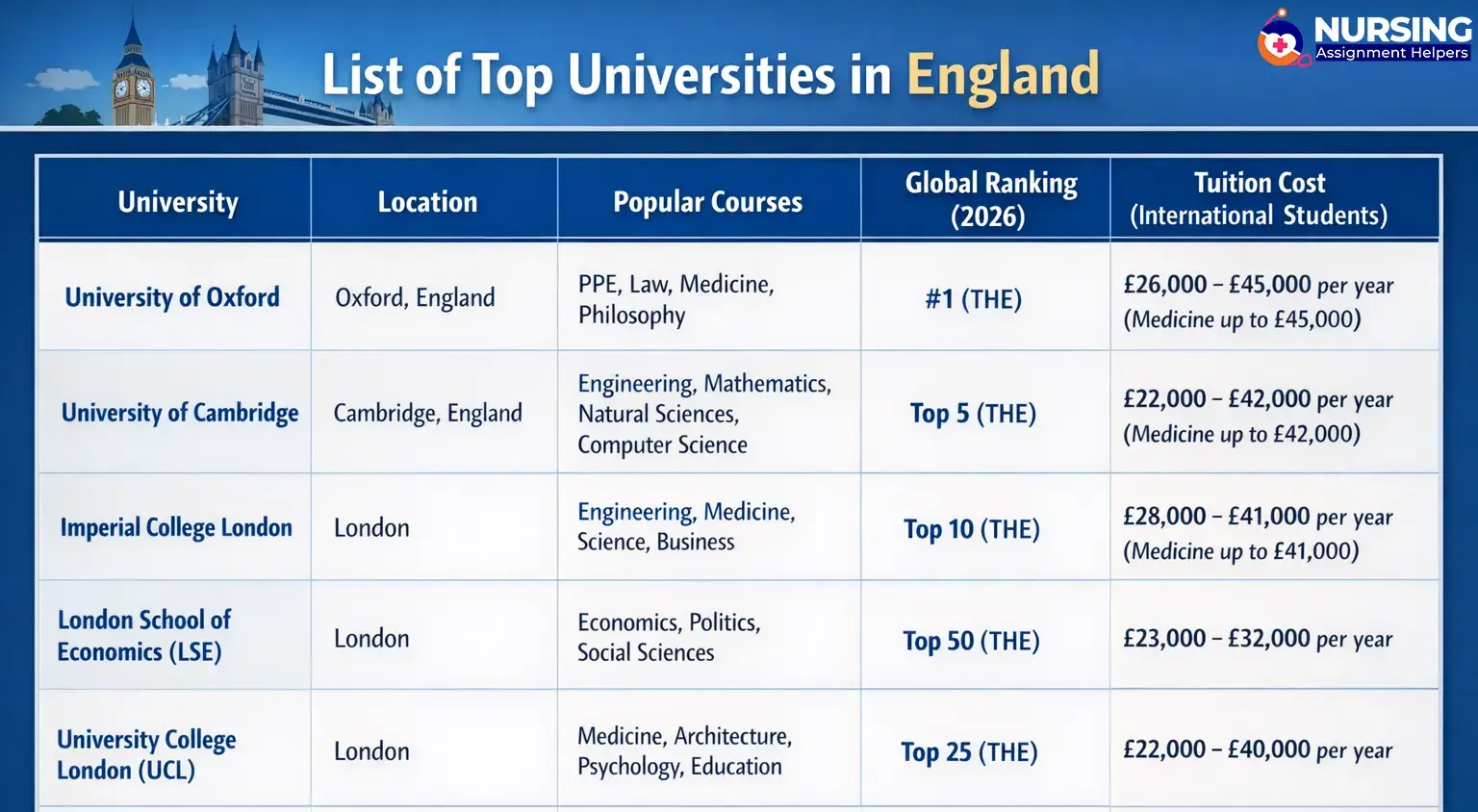
Table of top universities in England.
Now come on! Let’s dive deep into each one of these.
University of Oxford
Located in England, the University of Oxford is one of the world’s oldest and most prestigious universities. Moreover, it was built in the 12th century and is known for its tutorial teaching model, where students receive personalised academic guidance.
Furthermore, it offers different popular courses, including the PPE, Medicine, Law, Philosophy, and Literature.
Until now, it has produced numerous prime ministers, Nobel prize winners, and world leaders. It offers a rich student community, extensive extracurricular opportunities, a sports club, and cultural societies that provide both academic and personal development.
University of Cambridge
Another best universities in England is the University of Cambridge. Located in Cambridge and established in 1209, this university is known for its scientific breakthroughs and research excellence. Also, it offers courses like Science, engineering, mathematics ,and research. This university is also known for its innovation hub.
Did you know that Isaac Newton, Charles Darwin, and Stephen Hawking are its Alumni among others?
This just shows the level of education provided here.
Imperial College London
If you are looking to study science, mathematics, engineering, or technology, then Imperial College London is the best option, as their main focus is on STEM. They are the powerhouse and can provide you with strong industry partnerships and innovation initiatives.
London School of Economics and Political Science (LSE)
Located in London, the London School of Economics and Political Science is a globally recognised college offering different courses like economics, politics, and social sciences. Additionally, it is known for producing policymakers, economists, and global leaders.
University College London (UCL)
If you are looking to study in England, then the University College of London (UCL) is also a great choice. Located in London, UCL combines academic excellence with diversity and global collaboration. Furthermore, it is quite popular for subjects like Medicine, Architecture, Psychology, and Law.
List of Best Universities in the UK (Including Scotland, Wales & Northern Ireland)
Apart from England, other nations like Scotland, Wales, & Northern Ireland also have reputed institutions where you can pursue higher studies. The question is what are:
Let’s have a look at the table:
| University | Location | Global / UK Ranking (2026) | Popular Courses | Tuition Cost (International Students) |
|---|---|---|---|---|
| University of Edinburgh | Edinburgh, Scotland | Global Top 20 / UK #5 | Medicine, AI, Humanities, Science | £20,000 – £38,000 per year (Medicine up to £38,000) |
| University of Glasgow | Glasgow, Scotland | Global Top 100 / UK #8 | Medicine, Engineering, Social Sciences | £18,000 – £35,000 per year (Medicine up to £35,000) |
| Cardiff University | Cardiff, Wales | Global Top 200 / UK #15 | Journalism, Business, Engineering | £17,000 – £30,000 per year |
| Queen’s University Belfast | Belfast, Northern Ireland | Global Top 200 / UK #18 | Law, Medicine, Engineering | £16,500 – £30,000 per year (Medicine up to £30,000) |
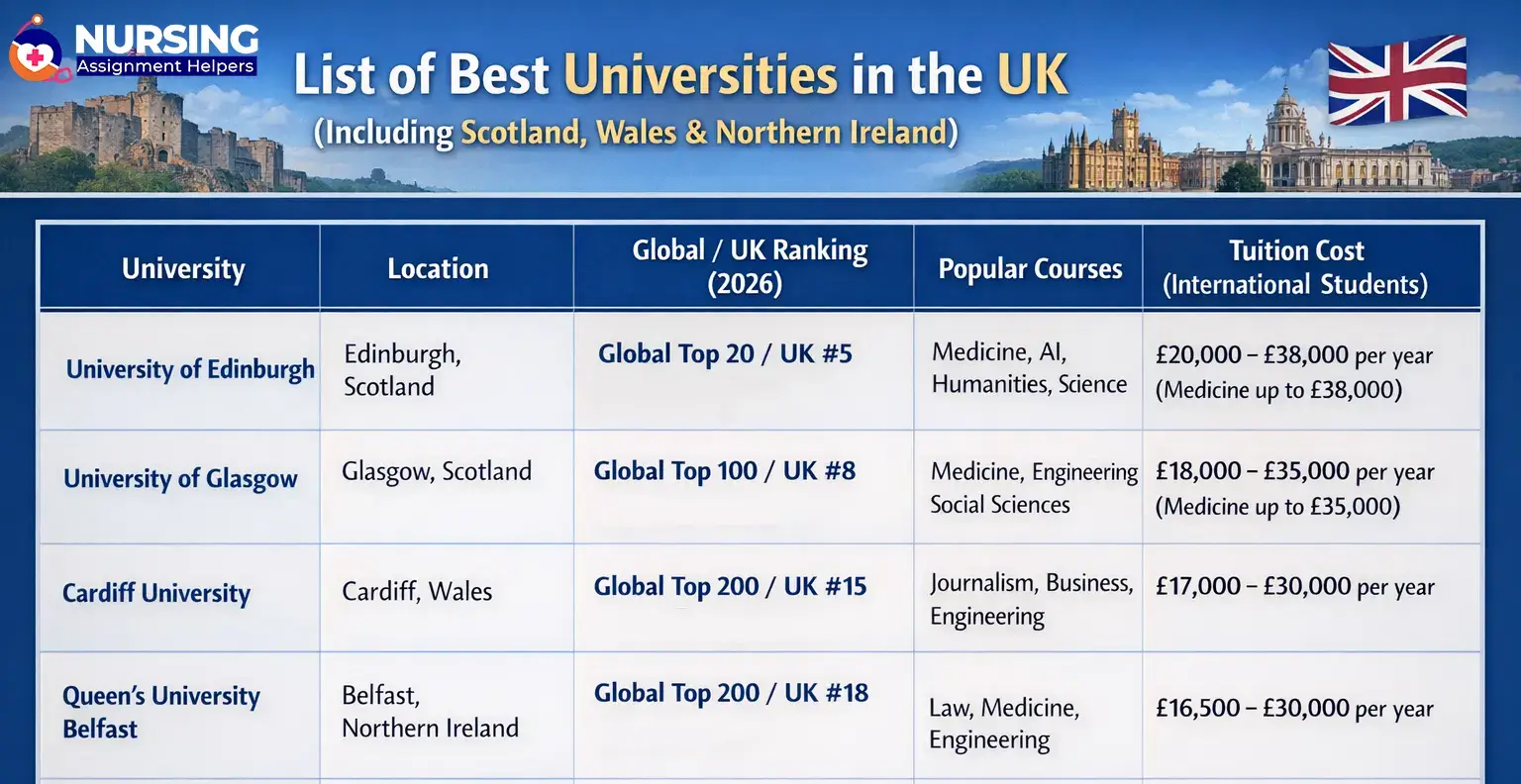
Now, come on! Let’s explore each of these in detail.
University of Edinburgh
The University of Edinburgh is one of Scotland’s most prestigious research universities which was founded in 1582. Furthermore, it attracts a diverse international student population.
- Ranking: Currently it ranks on the global Top 20 / UK #5 (THE 2026)
- Popular Courses: Furthermore, it offers different courses like Medicine, AI, Humanities, and Science
- Features: This university is known for its prestigious research programs, high international student population, and strong career outcomes
University of Glasgow
It is a historic Russell Group university that is known for its academic excellence across multiple disciplines. Furthermore, it was founded in 1451.
- Ranking: It is currently ranking globally on Top 100 / UK #8 (THE 2026)
- Popular Courses: This university is known for offering medicine, Engineering, Social Sciences, and life sciences
- Highlights: The University of Glasgow has one of the best research-intensive, strong industry links and a vibrant student life, which makes it the best option.
Cardiff University
Cardiff University is Wales’ leading university, which was founded in the year 1883. This university is known for its incredible educational system, combining strong academics with a dynamic campus experience.
- Ranking: It ranks globally under Top 200 / UK #15 (THE 2026)
- Popular Courses: Furthermore, some of its popular courses include journalism, Business, Engineering, Healthcare
- Highlights: This university is popular for its inclusive campus, modern facilities and active student societies
Queen’s University Belfast
Queen’s University Belfast is Northern Ireland’s top university, which was founded in 1845. Furthermore, it is known as an innovation hub, offering high-quality education and research opportunities.
- Ranking: Currently, it is on the list of Top 200 / UK #18 (THE 2026)
- Popular Courses: Additionally, you can field courses like Law, Medicine, Engineering, Business
- Highlights: This university has a huge modern campus, international student support, and strong graduate employability, making it the best choice.
Complete List of British Universities
Our list of British universities includes institutions across England, Scotland, Wales, and Northern Ireland.
Let’s have a look at them:
Universities in England
Here are the top 10 overall universities in England, offering the best study and career growth opportunities to students.
- Oxford
- Cambridge
- Imperial College London
- UCL
- King’s College London
- University of Manchester
- University of Leeds
- University of Birmingham
- University of Nottingham
- University of Bristol
Apart from this, some of the other popular universities known for their particular courses include:
- University of Exeter – strong in business, humanities, and environmental sciences
- University of Southampton – engineering, computer science, oceanography
- University of Sheffield – health sciences, engineering, social sciences
- Durham University – strong collegiate system, excellent humanities programs
- University of Warwick – business, economics, engineering, social sciences
Universities in Scotland
If you are planning to study in the University of Scotland, then here are some greatest options for you to consider.
- Abertay University
- Edinburgh Napier University
- Glasgow Caledonian University
- Heriot-Watt University
- Queen Margaret University
- Robert Gordon University
- University of Aberdeen
- University of Dundee
- University of Edinburgh
- University of Glasgow
- University of St Andrews
- University of Stirling
- University of Strathclyde
- University of the West of Scotland
Universities in Wales
Here are the top universities in Wales that you can definitely explore:
- Aberystwyth University
- Bangor University
- Cardiff Metropolitan University
- Cardiff University
- Swansea University
- University of South Wales
- University of Wales Trinity Saint David
Universities in Northern Ireland
Lastly, there are some great universities in Northern Ireland. They include:
- Queen’s University Belfast
- Ulster University
This list of universities in the UK can help students explore all academic options. Also, make sure to consider the courses offered here, the tuition fee, and other facilities before making your decision.
List of Oxford University Colleges
Our list of Oxford University Colleges dives deep into Oxford’s unique collegiate system, where the students belong to both a college and the central university. Thus, this means that while the university oversees lectures. Exams and degree standards, the colleges in Oxford provide accommodation, small group tutorials, dining facilities, and pastoral support.
Currently, the Oxford University has 39 autonomous colleges, each with its own industry, traditions, academic strength,s and community atmosphere. Thus, when students apply to Oxford, they either choose a specific college or submit an open application and are assigned one.
Additionally, despite the differences in size, age, and architecture, all of the colleges maintain the same academic standards and award degrees from the University of Oxford Itself.
Here is the table of all the oxford University colleges.
List of Oxford University Colleges
| College Name | Founded | Notable Strengths | Interesting Fact |
|---|---|---|---|
| Balliol College | 1263 | PPE, Politics, Philosophy | One of the oldest colleges; produced multiple UK Prime Ministers |
| Merton College | 1264 | Law, Humanities | Known for pioneering the tutorial system |
| Exeter College | 1314 | Theology, Classics | Historic chapel and strong academic tradition |
| Oriel College | 1326 | History, Law | Strong alumni network in politics |
| The Queen’s College | 1341 | Music, Mathematics | Known for its baroque architecture |
| New College | 1379 | English, History | Famous medieval cloisters and choir |
| Lincoln College | 1427 | Theology, Philosophy | Small and close-knit community |
| All Souls College | 1438 | Research-only (no undergraduates) | Fellows are selected through one of the toughest exams in the world |
| Magdalen College | 1458 | Humanities, Biological Sciences | Iconic tower and May Morning tradition |
| Brasenose College | 1509 | Law, Economics | Strong student satisfaction ratings |
| Corpus Christi College | 1517 | Classics, Linguistics | Small student population |
| Christ Church | 1546 | PPE, History, Law | Produced 13 UK Prime Ministers |
| Trinity College | 1555 | Engineering, Sciences | Strong academic performance |
| St John’s College | 1555 | Law, Medicine | One of the wealthiest Oxford colleges |
| Jesus College | 1571 | Law, Modern Languages | Strong Welsh connections |
| Wadham College | 1610 | Sciences, Social Sciences | Known for progressive traditions |
| Pembroke College | 1624 | Economics, Politics | Close to Oxford city centre |
| Worcester College | 1714 | Natural Sciences | Large gardens and a lake |
Now come on! Let’s have a look at the six top-tier colleges that you should consider.
Balliol College
Balliol College was founded in 1263 and is known for its politics, philosophy, and leadership courses. Furthermore, it is one of the oldest colleges at the University of Oxford. Over the centuries, this college has produced several British Prime Ministers and influential public figures. Also, Balliol is respected for its strong academic culture, lively student debates and commitment to critical thinking.
Magdalen College
Founded in 1458, Magdalen College is renowned for its strong arts and humanities tradition. Moreover, it is quite famous for its stunning architecture, beautiful deer park, and the iconic Magdalen Tower.
Additionally, it has a rich cultural heritage and is home to one of Oxford’s most celebrated choirs. Magdalen College combines academic excellence with a vibrant and historic college atmosphere.
Christ Church College
Founded in 1546, Christ Church is one of Oxford’s largest and most prestigious colleges. It is known for its historic campus, grand dining hall, and famous alumni, including numerous political leaders. The college has a strong reputation in subjects such as philosophy, politics, and history. Moreover, its impressive architecture has also made it a popular filming location.
Trinity College
The Trinity College was founded in 1555 and is known for its academic excellence and strong research performance. Furthermore, it consistently ranks highly for student satisfaction and even has a great academic record.
This college does offer a peaceful environment with beautiful gardens and a close-knit community. Also, the Trinity has built a strong reputation across the sciences, humanities, and social sciences.
St John’s College
Founded in 1555, St John’s College is one of the largest and most well-funded colleges at Oxford. It is financially well-resourced and research-focused. Additionally, it supports a wide range of academic disciplines. This college even offers extensive scholarships and research opportunities. With impressive architecture and spacious grounds, St John’s provides both strong academic support and a vibrant student life.
The best part is that each of these colleges provides the accommodation, mentorship and academic support you need to study abroad.
UK University Rankings 2026
In the UK university rankings 2026, universities are evaluated based on the following key factors. They include:
- Teaching Quality – They assess how effectively courses are delivered, which includes the student-to-staff ratios, quality of feedback, academic support and overall learning.
- Research Output – Additionally, they even measure the volume, quality and global impact of the research publications, innovation and research funding each university has secured.
- Student Satisfaction – Their rankings are also mostly based on the national surveys that reflect students’ views on teaching standards, course structure, campus facilities, and overall university experience.
- Employability – Furthermore, they even evaluate the graduate employment rates, career progression, industry links, internships, and average starting salaries after graduation.
- International Outlook – They even consider the diversity of international students and staff, along with the global partnerships and the worldwide academic collaborations.
These are the combined indicators that provide a balanced picture of the academic excellence, student experience, and career prospects.
Top 10 most Highly Ranked Institutions in the UK
| University | UK Ranking (2026) | Global Ranking (2026) |
|---|---|---|
| University of Oxford | 1 | 1 |
| University of Cambridge | 2 | 3 |
| Imperial College London | 3 | 10 |
| University College London (UCL) | 4 | 25 |
| London School of Economics (LSE) | 5 | 50 |
| University of Edinburgh | 6 | 20 |
| King’s College London | 7 | 35 |
| University of Manchester | 8 | 50 |
| University of Bristol | 9 | 60 |
| University of Warwick | 10 | 70 |
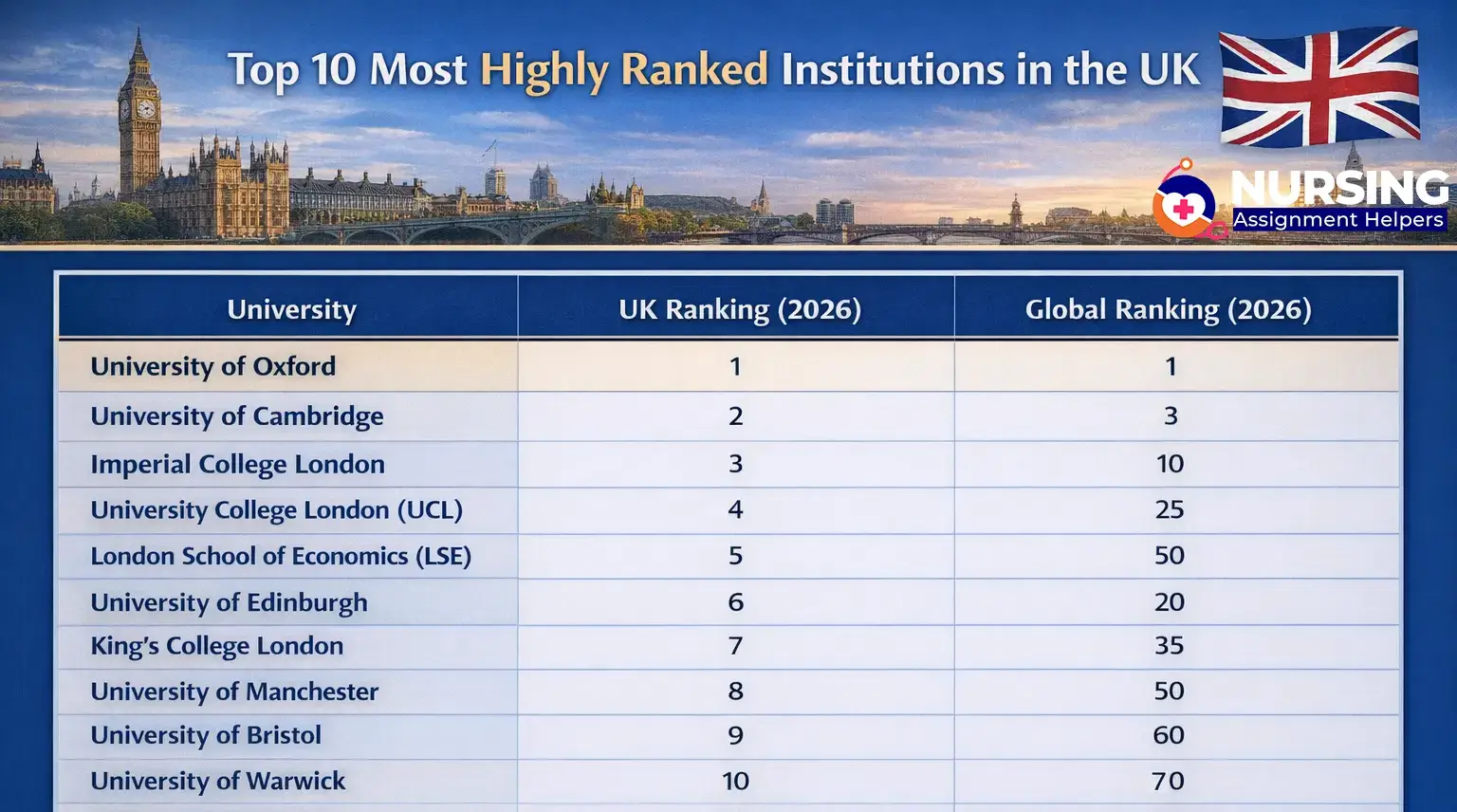
When choosing a university, rankings can guide you. However, you should also look at the cost and the courses offered before making the decision.
How to Choose the Right University in the UK
To choose the best university in the UK, here are some tips and tricks that you need to follow. They include:
Course Quality Over Ranking
Rankings do not matter as much as the course quality. A university may rank lower overall. However, it might still be the best choice for a specific subject or field. Therefore, the students should review:
- Subject-specific rankings
- Faculty Expertise
- Course content
This will help them ensure that the program aligns with their career goals.
Tuition Fees
The fees in the UK for international students may vary widely. It depends on the subject, level of study, and the university. Furthermore, the STEM and medical programs are usually more expensive. On the other hand, arts and humanities may cost less. You should also calculate the cost for accommodation, living expenses, and materials.
Scholarships
Many UK universities offer a range of scholarships so that international students can study without any problem. This can include:
- Merit-based awards
- Country-specific funding
- Research grants for postgraduate study
Before applying, make sure to check the eligibility criteria and application deadlines early.
Location Matters
The location of a university affects both lifestyle and costs. Urban universities in cities like London or Manchester may offer more networking and career opportunities. However, they do come with higher living expenses.
Similarly, the smaller towns provide a quieter study environment and a closer community feel. You should also consider the transport, safety, cultural amenities and access to internships when choosing your preferred location.
Career Outcomes
Graduate employability is a great factor in selecting a university. Therefore, you should look for placement opportunities, industry partnerships, and graduate employment rates for your chosen programs.
Student Life in British Universities
Student experience includes:
- Clubs and societies
- Research projects
- Cultural diversity
- Career services
Overall, the student life in British universities is vibrant and even provides opportunities for personal development alongside academics. Many universities even allow you to tour the campus before making the final decision.
Career Opportunities After Graduation
Since the UK degrees are highly respected globally, the graduates secure roles in:
- Finance
- Technology
- Healthcare
- Government
- Academia
Subject-Wise List of Universities in the UK
Whether you want to study medicine, engineering, business, finance or arts & humanities, we have divided the universities based on the subjects so that you won’t have any problem while making the decision. They include:
Medicine
- Oxford
- Cambridge
- UCL
Engineering
- Imperial
- Manchester
- Bristol
Business & Finance
- LSE
- Warwick
- London Business School
Arts & Humanities
- Edinburgh
- King’s College London
- SOAS
Future of UK Higher Education
Higher education in the UK is constantly changing, and even the universities are evolving to meet the needs of modern students and global industries. The future trends you can see include:
- Digital education has become increasingly important. Institutions are now offering online courses, hybrid learning models, and virtual labs. This provides accessibility and flexibility.
- Additionally, industry partnerships are becoming popular. They allow students to gain practical experience, internships, and exposure to real-world challenges, bridging the gap between academics and employment.
- Universities are also prioritising sustainability research, focusing on climate change, renewable energy, and environmental innovation to address global challenges.
FAQs About Universities in the UK
Q. How many universities are there in the UK?
There are more than 160 recognised higher education institutions.
Q. What are the top universities in England?
Oxford, Cambridge, Imperial, UCL, and LSE dominate the list of top universities in england.
Q. Is Oxford better than Cambridge?
Both are globally prestigious; choice depends on subject and preference.
Q. Which university is best for international students?
UCL, Manchester, Edinburgh, and King’s College London are highly international.
Q. What is included in the list of best universities in uk?
Top research universities, regional institutions, and specialist universities.
Conclusion
In a nutshell, the UK continues to lead global higher education. Its universities combine tradition, research excellence and modern innovation to provide students with transformative learning experiences.
Students have access to a diverse range of academic pathways and career opportunities. As per the UK university Rankings 2026, British universities remain globally competitive in teaching, research, and graduate employability. For students, success lies in selecting the right course, understanding career goals and choosing an institution that aligns with personal ambitions.
Moreover, the UK remains a destination where academic excellence meets opportunity. This makes it one of the most attractive places in the world to study and build a future.