


 info@nursingassignmenthelpers.co.uk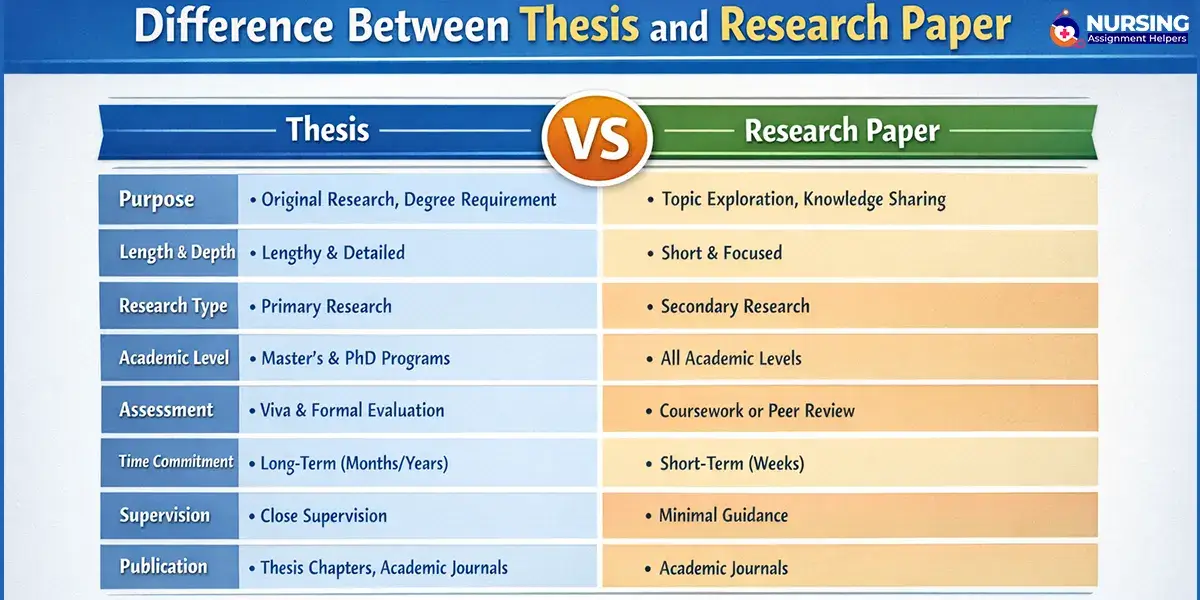
 By
By The difference between Thesis and Research Paper is something that every research student must know clearly.
Both types of academic writing necessitate research, organized reasoning, and critical thinking, but both are used with various academic objectives.
A thesis is a large and original contribution to knowledge, whereas a research paper is aimed at the analysis or discussion of a particular topic in a shorter format.
It is easy to get confused as both demand referencing, evidence, and academic rigour. Nevertheless, their scope, depth, and expectations differ greatly.
So, no matter if you are an undergraduate, postgraduate, or doctoral student in the UK, understanding the key difference between thesis and research paper is crucial to your success.
It can help you in planning your research journey effectively and meet all the assessment criteria. So, in this blog, we will explore all the key differences between thesis and research paper.
What Is a Thesis?
A thesis is a long academic paper that is developed as part of a postgraduate degree, e.g., a Master’s degree or a research degree in the UK. It shows original research done by the student and shows their knowledge on the subject.
Thesis (also known in UK universities as a dissertation) at Master’s level is usually 12000 to 20000 words (90-110 pages). Depending on the institution and the field, the dissertation of a PhD can reach up to 70,000-100,000 words(160-260 pages).
Key Characteristics of a Thesis
- Original research question
- Thorough literature research
- Comprehensive research methodology
- Data analysis and data collection
- Independent arguments that are supported by evidence
- Viva examination (PhD students)
A thesis takes months or even years to be researched. Students are required to develop a study, gather primary or secondary data, and discuss the results and offer new knowledge to their profession.
What Is a Research Paper?
A research paper is a shorter academic paper that explores a specific subject or issue. In the UK universities, it is usually allocated at undergraduate and postgraduate levels.
Typically, it is between 2,500 words and 10,000 words, but journal submissions can be different. Original data collection is not always needed in a research paper. It can be used to interpret findings, examine current literature or provide a narrowed study.
Key Characteristics of a Research Paper
- Narrow and specific topic
- Structured argument
- Evidence-based discussion
- Academic referencing
- Well-defined introduction, body, and conclusion
Coursework, journal publications, or conference presentations are also commonly done using research papers. Critical analysis is really important in research paper. Here is how you can do it.
What Is the Difference Between Thesis and Research Paper?
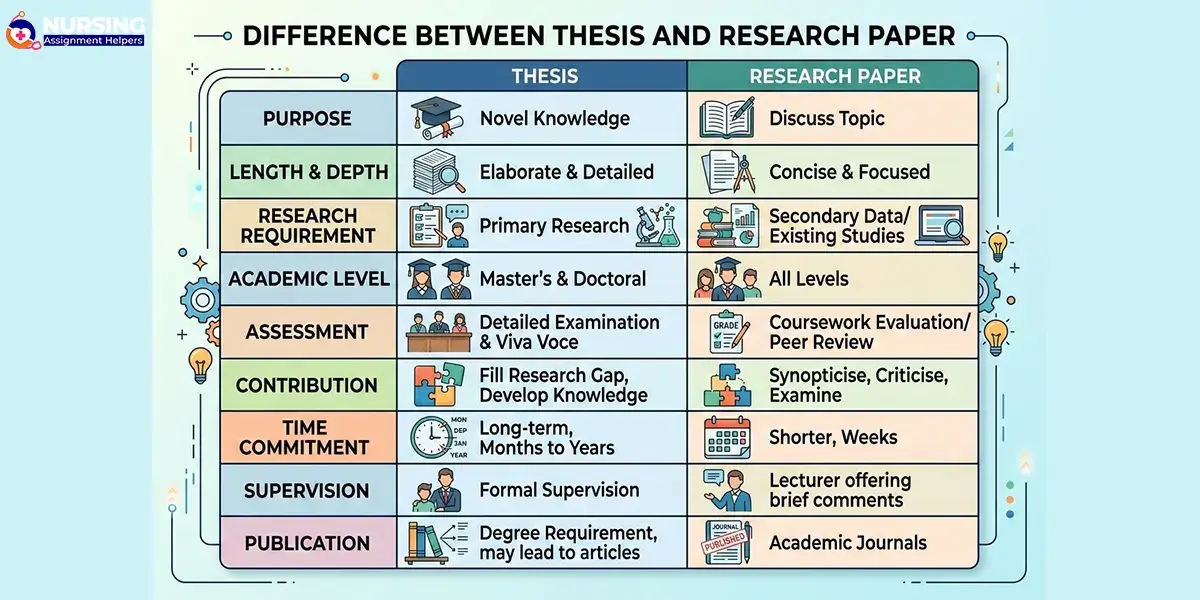
There is a difference between thesis and research paper in terms of purpose, scope, length, originality, and level of academic writing.
Although both are associated with research and critical thinking, they are not associated with the same expectations. The major thesis and research paper difference include:
1. Purpose
A thesis is evidence of perfection in a subject, and it adds novel knowledge. It is necessary to achieve postgraduate degrees.
A research paper considers or discusses a topic over a specified area. It is instead an expression of knowledge and critical skill as opposed to a lot of original input.
2. Length and Depth
A thesis is much more extended and elaborate. It also has detailed sections like literature review, methodology, results, and discussion.
A research paper is concise. It deals with a narrow topic without a long history.
3. Research Requirement
Primary research is usually a part of a thesis, and it can be in the form of surveys, interviews, experiments, or case studies.
A research paper can either be based on secondary data or on the basis of the studies that have already been conducted, but some of them contain small-scale original research.
4. Academic Level
Institutions in the UK require a thesis in master’s and doctoral programmes.
Papers are typical at all levels, and they include even undergraduate coursework.
5. Assessment Process
A thesis is examined by a detailed assessment process and, in the case of the PhD, a viva voce examination.
A research paper is evaluated as a course work or by journal editors when it is submitted to be published.
6. Scope and Contribution to Knowledge
A thesis is supposed to introduce a research gap and fill it with systematic research. It focuses on the development of knowledge in a field.
A research paper can synopticise, criticise, or examine the current knowledge. It is not necessarily out to present a new theoretical framework or a body of data.
7. Time Commitment and Academic Planning
Long-term planning is required for a thesis. It is normally worked on over a number of months by the master’s students. The PhD candidates spend several years.
Depending on the level of research that is necessary, a research paper can be done in a few weeks.
8. Supervision and Guidance
Formal supervision is part of thesis writing. In the UK universities, academic supervisors are assigned, and they direct the research design, theoretical framework, and analysis.
Research papers can include feedback provided by lecturers, but the degree of supervision is not as high.
9. Publication Opportunities
Academic journals normally publish research papers. Undergraduate and postgraduate learners can deliver good papers to peer-reviewed platforms.
Publication can also be brought about by a thesis. Most PhD candidates of PhD turn thesis chapters into journal articles. The very thesis, however, is mainly an academic imperative but not a journal submission.
So, these are the main thesis and research difference.
Thesis vs Research Paper: Structural Comparison
Understanding the structure of both a thesis vs research paper clarifies the difference further.
Structure of a Thesis
- Abstract
- Introduction
- Literature Review
- Methodology
- Results
- Discussion
- Conclusion
- References
- Appendices
Every section is elaborated and backed by a lot of scholarly materials.
Structure of a Research Paper
- Abstract (not important every time)
- Introduction
- Main Discussion or Analysis
- Conclusion
- References
The layout is simplified and narrows down to making a concise point.
Evaluation Criteria in UK Universities
The two formats are very different in terms of assessment criteria.
An evaluation of a thesis is done on:
- Originality
- Research design quality
- Critical practice in literature
- Analytical depth
- Contribution to the field
A research paper is assessed on the basis of:
- Argument clarity
- Evidence use
- Critical thinking
- Structure and coherence
- Referencing accuracy
The thesis marking rubric is of greater academic value because it is used to grant a degree.
Similarities Between Thesis and Research Paper
In spite of differences, there are similarities:
- Professional academic references
- Structured academic format
- Citing references (Harvard, APA, OSCOLA, etc.)
- Demand for objectivity and lucidity
- Evidence-based arguments
They both require academic discipline and integrity.
Choosing the Right Approach
The choice between a thesis and a research paper is not normally free among students. Requirements are predetermined by academic programmes. Research papers are a course of study for undergraduate students. Postgraduate students are expected to write a thesis in order to graduate.
Learning the difference between thesis and research paper enables the student to mentally and academically prepare themselves for what is yet to come in the academic development of the student.
Final Words
A clear understanding of the difference between thesis and research paper isa favorable step towards academic success in UK higher education.
A thesis is a large-scale, original research undertaken at a postgraduate level, which involves much time, research supervision, and scholarly input.
A research paper implies concentrated analysis in a shorter format, and it is typical at a variety of academic levels.
Thus, the identification of structural, methodological, and evaluative divergences would make sure that the students enter every task with proper preparation, thorough research, and academic approach.
Frequently Asked Questions (FAQs)
Q. Is a thesis the same as a dissertation in the UK?
The term dissertation is widely applied in the UK universities to refer to Master’s level research, whereas the term thesis is frequently applied to refer to PhD-level research.
Q. Are undergraduate students able to write a thesis?
In the UK, undergraduate programmes seldom entail a dissertation. Final-year projects can be shorter versions of mini-dissertations.
Q. How long is a research paper in UK universities?
The majority of research articles have a range of between 2,500 and 10,000 words, depending on the module and academic level.
Q. Does a thesis always require primary research?
Primary data collection is necessary in most postgraduate theses. There are fields where secondary data analysis can be done, provided that it is academically justified.
Q. Is it easier to write a research paper compared to a thesis?
Thesis topic can be inspired by a research paper. The research question and methodology can be developed further to become a bigger project.
Q. Is supervision mandatory for a thesis?
Yes. The UK universities allocate supervisors in Master and PhD theses.
Q. Are research papers published more often than theses?
Journals are more frequently used in publishing research papers. Theses can be revised to become journal articles.
Q. Is a referencing style needed in both of them?
Yes. They both need to be referenced correctly with approved academic styles.



 UK Cities