 By
By Behind every successful treatment is not just science or medicine, but also a deep understanding of the human psyche. Nurses play a crucial role in understanding a patient’s mind and nature for their treatment. This easily explains the importance of psychology in nursing. In addition, psychology is highly significant in nursing, as it enables nurses to provide holistic care to their patients. As a result, there will be an improvement in the overall patient’s outcome.
In this blog, I will provide you with an overview of psychology. Also, I will discuss the significance of psychology in nursing and how I used it to take care of my patients more effectively. So, are you ready to refine your patient’s outcome? Let’s dive into it!
Introduction to Psychology in Nursing
Before moving on to the importance of psychology in the nursing profession, let’s first get a brief introduction to psychology in nursing.
Psychology in nursing simply means studying human behaviours and emotions. This eventually leads to holistic patient care, along with a better relationship between the patient and the nurse. This helps nurses take better care of every patient, enhancing the patient’s outcome.
Key Psychological Aspects of Nursing:
Understanding Behaviour:
To begin with, psychology helps nurses understand why a patient acts or feels in a certain way. This enables them to take better care of patients, leading to an enhanced overall patient experience.
Better Communication:
In addition to this, knowledge of psychological principles allows nurses to understand how they can communicate with each patient. As every patient has different personality traits, they require different communication methods. Furthermore, it also helps patients to trust nurses and discuss their issues.
Managing Stress:
Besides that, psychology allows nurses to acknowledge patients’ emotions. Additionally, it enables them to understand how to react to a patient’s trauma or illness. It not only helps manage the stress of patients but also of nurses.
What is Psychology?
Now, the main question is, ‘What actually is Psychology?’
Psychology is basically the scientific study of the mind and behaviour. In simpler words, it allows peers to study the thoughts, feelings, and behaviours of humans and animals. In addition to this, psychology plays a crucial role in predicting an individual’s behaviour based on their emotions, intelligence, and personality. Moreover, it has 5 major sub-fields, including:
- Clinical
- Cognitive
- Developmental
- Social
- Forensic
Psychology is a vast field, and these are just the most common sub-fields.
Relationship Between Psychology and Nursing
As we have understood the basic concepts of psychology, let’s take a look at the relationship between psychology and nursing.
Indeed, nursing and psychology are two different fields, but they are still connected. Nursing focuses on ‘how’ the patient is behaving. Psychology, on the other hand, focuses on ‘why’ the patient is behaving in a certain way. Using the principles of both concurrently helps nurses improve patients’ results.
The following are the key aspects of the relationship between psychology and nursing:
Holistic Patient Care:
Professional nurses smartly blend their nursing theories and practical learning with psychological principles to provide holistic care to patients. For instance, understanding the behavioural psychology of each patient allows them to manage their behaviours in various situations.
Communication with Patients:
Furthermore, nurses often use developmental psychology in nursing care. It helps them tailor their care plans for patients of different age groups. In addition, it also helps them communicate with their patients more effectively.
Mental and Emotional Support:
Moreover, psychology allows you to understand the behaviours and emotions of individuals. Hence, understanding the patient’s psyche enables nurses to offer mental and emotional support to the patients. Moreover, nurses can use psychological principles to understand the triggers of patients. Thus, they can use several relaxation techniques to calm down their patients. As a result, they can improve the patient’s recovery.
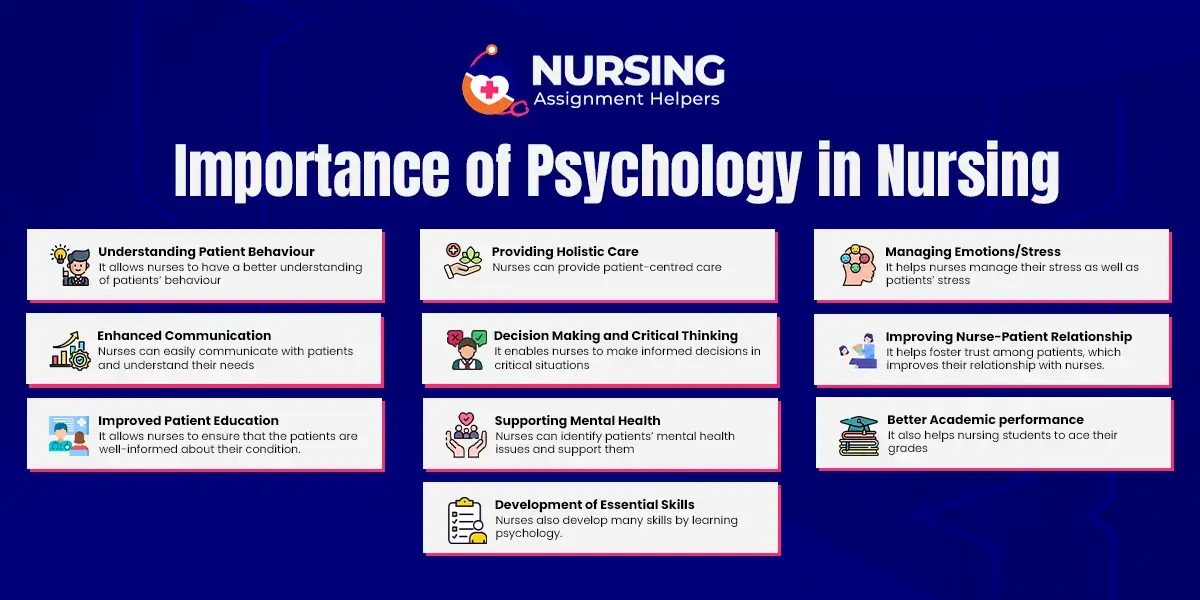
What are the 10 Importance of Psychology in Nursing?
Here comes the main question, ‘Why psychology is important in nursing?’ Well, being familiar with the importance of psychology in nursing practice is quite crucial for nurses like you. This not only enables you to take better care of your patients but also helps you manage your own well-being.
I have listed the importance of psychology in nursing in points for a better understanding:
10 Importance of Psychology in Nursing:
1. Understanding Patient Behaviour
Firstly, every patient reacts in a totally different way to their pain or illness. Some of them may experience stress and anxiety. However, others may become aggressive. That’s when psychology comes to the rescue! You can use psychological principles to understand and effectively manage these behaviours. This is actually a key importance of studying psychology in nursing.
2. Providing Holistic Care
Patients can experience different symptoms despite having the same health issue. That’s when psychology comes in! It allows you to understand the symptoms and issues of each patient. Understanding the physical, emotional, and psychological issues and needs of patients will enable you to provide holistic care to your patients.
3. Managing Emotions and Stress
Moreover, psychology allows you to understand the emotions and concerns of your patients in a better way. As a result, it will be easier for you to manage their stress and anxiety. This also helps patients to recover more quickly. In addition to this, nurses also get exhausted during their clinical rounds. However, using psychological principles helps you manage your stress as well.
4. Improving the Relationship Between Nurse and Patient
In addition to this, using psychology in nursing profession also improves the relationship between a nurse and a patient. Psychology helps you show that you actually care about your patients, which fosters trust among them. Furthermore, psychology also teaches you to actively listen to your patients, respond in an appropriate way, and show empathy. This allows patients to feel heard. As a result, they will share their problems with you.
5. Enhancing Communication Skills
One of the key components of nursing is effective communication skills. Blending psychology with nursing helps you communicate with your patients in a more compelling way. Besides that, it enables you to decode the patients’ tone, body language, and facial expressions. This helps you understand the needs of your patients and create a patient-focused care plan.
6. Decision Making and Critical Thinking
Besides that, psychology allows you to analyze patient behaviour and make decisions after considering the risks. This ultimately enhances your critical thinking and decision-making skills. Also, having a deeper knowledge of psychological principles enables you to respond efficiently even in emergencies.
7. Improved Patient Education
Furthermore, psychology is quite important in nursing as it helps you understand how a patient learns and processes information. This enables you to tailor your teaching methods to the learning style of each patient. Along with this, it also allows you to ensure that the patients are well-informed about their condition. Due to this, patients can also participate in their care decisions.
8. Supporting Mental Health
One of the most important uses of psychology in nursing is managing the mental health of patients and supporting their well-being. Psychology allows you to identify symptoms of anxiety, depression, stress, or other cognitive disorders. This will help you offer better care to your patients, enhancing the overall patient outcome.
9. Better Academic performance
Additionally, the importance of psychology in nursing assignments is one of the things we can’t overlook. Using psychological principles, which include self-learning and active learning, can help nursing students not only excel in their assignments but also ace their grades in exams. Moreover, these techniques also help them to remember nursing concepts throughout their careers. Besides that, you can also seek help from a professional nursing assignment writing service.
10. Development of Essential Skills
Last but not least, psychology helps you to develop several skills essential in nursing. A few of them include:
- Problem-solving
- Decision-making
- Critical thinking
- Active listening
- Therapeutic communication
- Interpreting facial expressions, tone, and body language
- Assess mental state
What is the Role of Psychology in Nursing Practice?
I hope that you have clearly understood why psychology is important in nursing. Now, let’s understand the role of psychology in nursing.
If you are a practising nurse or an internee, you might not be able to use psychology in nursing practice. One of the most common reasons may be that you are not aware of its role. Hence, to ensure that you use psychology during your practice, I have provided you with some of its key roles in nursing:
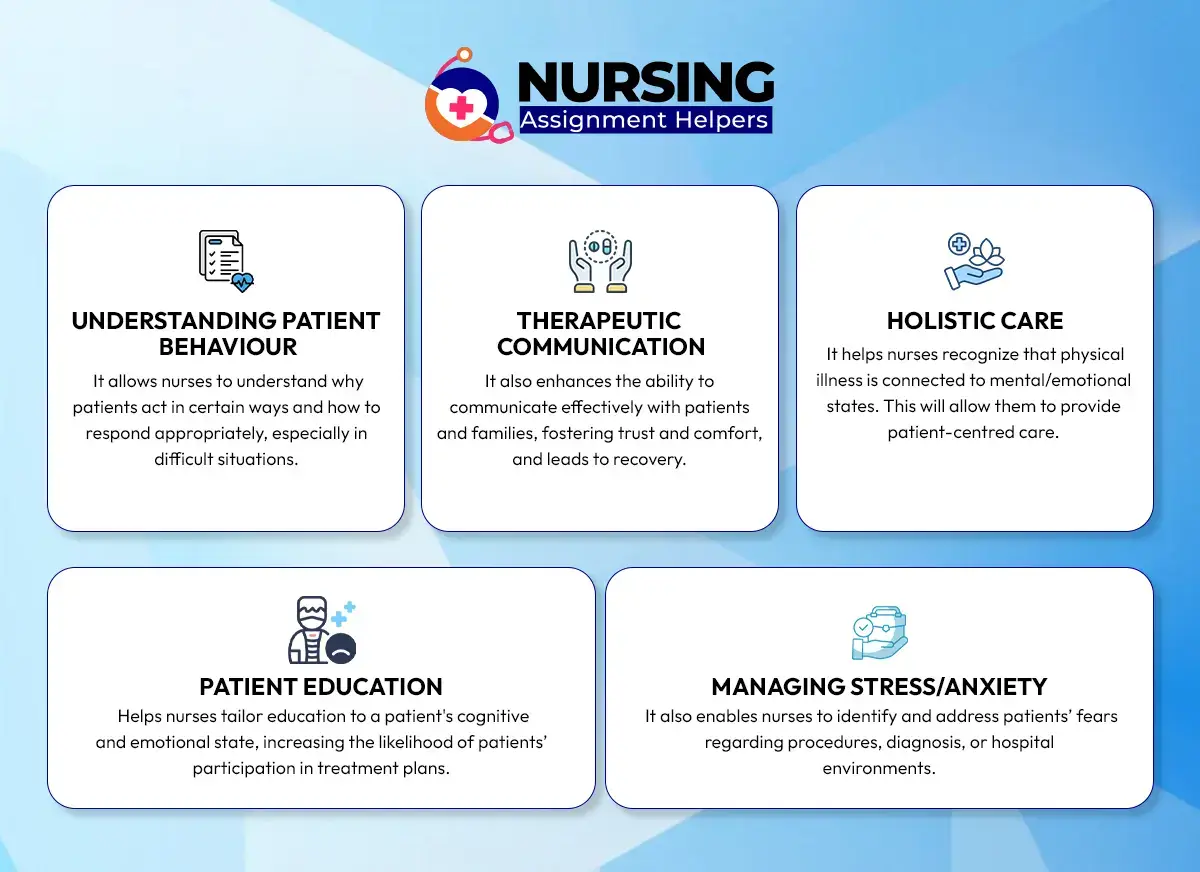
Understanding Patient Behaviour and Emotions:
First and foremost, as a nurse, your priority should always be your patients. For that, you must understand the behaviour and emotions of your patients and cope with them calmly. Psychology will help you understand why a patient behaves, thinks, or feels in a specific way. Additionally, deep knowledge of psychological principles might also help you identify whether the behaviour is in response to illness, stress, or trauma. To help patients dealing with stress or trauma, you should:
- Show empathy
- Reassure them
- Provide emotional validation
For Example:
If a patient is anxiously waiting outside the operating theatre for their turn, you must calm them. Ask them about their fears, give a brief on the procedure of surgery in a calm tone, and assure them that the surgery is not complicated. This will help you reduce the patient’s stress.
Enhancing Patient Adherence and Motivation:
In addition to this, one of the most challenging tasks for nurses is motivating patients to follow treatment plans and take medication regularly. This is when you should use psychology in your practice.
For Example:
You can use psychological principles to help patients with chronic illness stick to their diet and participate in their treatment plan. You can also educate them about the future aspects of the illness if not treated. This might motivate them to take medications regularly and change their lifestyle. This will also help you improve patient recovery.
Encountering Emotional Trauma:
Besides that, if your rotation is in the Intensive Care Unit (ICU), then you might encounter emotional trauma frequently. Therefore, you must have a deep understanding of coping mechanisms. This will help you support the patient or the patient’s family during critical situations.
For Example:
You must provide clear, but small chunks of information about the patient’s condition. Also, if a family member is crying, acknowledge their emotions and actively listen to them.
Managing Burnout:
Along with this, if you are not in good health, whether it is physical or mental, you won’t be able to take care of your patients. One of the most common challenges that nurses have to face is stress and burnout. However, being aware of psychological techniques will help you calm yourself and feel relaxed.
For Example:
Use the grounding technique before entering a patient’s room. This will help you feel calmer. Additionally, separate your personal and professional life to avoid exhaustion.
Creating a Positive Healthcare Environment:
Nurses are required to work in different teams. Hence, understanding personality differences and communicating effectively with your coworkers is essential. It plays a crucial part in building a positive healthcare environment.
For Example:
You can do the following things create a positive environment with your coworkers:
- Listen to them and show empathy
- Help them with a complex task
- Share positive feedback on their work
Applications / Uses of Psychology in Nursing
Just understanding the importance of psychology in nursing is not enough. Rather, you must know the use of psychology in nursing. Don’t know how and where to use it? No worries! I’ll help you.
To ensure that you deeply understand its application, I will share a few real-life nursing scenarios where I usually apply psychological principles.
Application of Psychology in Real-Life Nursing Scenarios
Managing Anxiety and Refusal of Care Among Patients (Medical/Surgical):
First and foremost, hospitalization, surgery, or a lifestyle change can easily trigger a patient. They can often experience shock, fear, stress, or anxiety. To avoid this, nurses use different psychological principles to manage their anxiety.
Real-life Scenario:
Whenever I encounter patients awaiting surgery or refusing to take part in treatment, I use psychological principles. For the surgery awaiting patient, I use the grounding method and communicate with them very calmly. On the other hand, for the patient refusing to cooperate during treatment, I often use behavioural psychology to identify their fears and motivate them to participate in their treatment.
Supporting Patients with Chronic Illness (Oncology):
In addition to this, supporting patients with chronic illness can be challenging for nurses as well. It requires them to listen to them actively and show empathy. Along with this, nurses are required to provide emotional validation and implement effective coping strategies.
Real-life Scenario:
If a patient is diagnosed with cancer, they often feel hopeless, which ultimately leads to depression. Besides that, it can also cause a lack of motivation for treatment. In such situations, I use psychology to foster the patient’s coping mechanism. Moreover, I address their fear of death and help them boost their emotional, mental and spiritual well-being.
Pediatric Care:
Apart from this, young children are mostly afraid of needles and medicines. Due to this, their treatment often takes more time and effort than that of adults. However, to avoid this, nurses use developmental psychology to distract children so that the doctors can continue their treatment.
Real-life Scenario:
When I have to deal with young children who are afraid of their treatment, I use playful methods to distract them. In addition to this, a child often needs reassurance that a certain thing won’t hurt them. Using psychological principles, I usually explain the procedure to them in very simple terms, which eventually reduces their fear.
Communicating with Cognitively Impaired Patients (Gariatric):
Taking care of elderly patients can also be pretty difficult. However, psychology helps nurses to understand their emotions and mental state. Due to this, nurses calm them and listen to their issues patiently.
Real-life Scenario:
One of the most common issues among elders is dementia. I have also taken care of many such patients. However, dealing with dementia patients requires a lot of patience and strng gras on psychological principles. A few days back, a patient with dementia had become highly uncooperative and anxious during his morning routine. Instead of arguing with him, I use psychological strategies to understand his concerns and validate his feelings. As a result, I was able to foster his trust in me and reduce his anxiety.
Palliative Care:
Losing your loved ones or hearing that you don’t have much time left can shatter you into pieces. In palliative care, nurses are required to offer emotional support not only to patients but also to their families. However, to offer support, nurses must deeply understand and feel their grief.
Real-life Scenario:
Whenever I am in such a heartbreaking situation, the first thing I do is to actively listen to patients or their families. If patients cannot be recovered by any medication, I ask them to remember all the good times that they spent with their loved ones. To make them feel like I am actually listening to them, I even ask them to share their happiest moments. This helps them remember all the good things before closing their eyes. On the other hand, the family members who have lost their loved ones also need emotional support and availability. To ensure that they don’t feel lonely, I sit with them and actively listen to them. I also show empathy and assure them that their loved one must be in a better place.
What is the Importance of Psychology for Nursing Students?
| Did you know? “The NMC register of all nurses, midwives and nursing associates who can practise in the UK has reached a record 853,707 – around two percent of the total working age population.” (UK NMC) |
After reading this blog, you must have developed a misconception that psychology is only significant in nursing practice. However, this is not true. Indeed, we can’t overlook the Importance of Psychology in Nursing, but psychology also plays a crucial role in nursing students’ lives.
The following are some reasons why psychology is important for nursing students:
Prepares for Real-World Experience:
Nurses are required to understand human emotions and behaviour. And psychology plays a crucial role in assessing human behaviour and emotions. Therefore, studying psychology can be quite beneficial for nursing students. It also helps them understand how to deal with patients and other staff. In simpler words, psychology prepares nursing students for real-world experience.
Teaches Handling Emotional Challenges
In addition to this, nurses must be highly proficient in handling emotional challenges. Whether a patient is anxious or there is an emergency situation, a professional nurse must use psychological strategies to handle the situation gracefully. Hence, having a grasp on psychological principles allows nursing students to learn how to handle emotional challenges without panicking.
Develops Strong Communication Skills:
To become a good nurse, you must be able to properly communicate with your patients. This helps you understand their needs and issues. However, many patients do not communicate directly. Thus, to understand the needs of your patient, you must have a strong grasp of psychology. It helps you decode the patient’s tone, facial expressions, and body language.
Conclusion
The Conclusion of psychology in nursing simply lies in the use of psychological strategies in nursing practice for the betterment of patients. Nurses must be aware of the importance of psychology in nursing. Because having a strong grasp on psychology allows nurses to:
- Understand patients’ behaviour and emotions
- Manage stress and anxiety
- Communicate effectively
- Build therapeutic relationships
In addition to this, it also helps nurses enhance patients’ outcomes and support their own well-being.
I hope this blog helps you understand the relevance of psychology in nursing and enables you to apply psychological strategies in nursing practice as well.
FAQs
Q. What are the 5 C’s of nursing?
Ans: The 5 C’s of nursing are:
- Compassion
- Competence
- Confidence
- Conscience
- Commitment
Q. What are the 4 techniques of nursing?
Ans: The 4 techniques of physical nursing assessment are:
- Inspection
- Palpation
- Percussion
- Auscultation
Q. What are the 4 principles of nursing?
Ans: The 4 ethical principles of nursing are:
- Autonomy
- Beneficence
- Nonmaleficence
- Justice
Q. What are the 10 commitments of nursing?
Ans: The following are the 10 commitments of nursing:
- Promoting health
- Supporting patients
- Visible leadership
- Patient-centred care
- Collaborating with patients and their families
- Ensuring the right staff at the right place
- Evidence-based practice
- Use of technology
- Education and training
Q. What is the main importance of psychology?
Ans: The main importance of psychology is understanding and predicting the changes in human behaviour and emotions. This helps to improve the well-being of individuals.
Q. What are the 5 importance of the nursing process?
Ans: The 5 key areas of importance of the nursing process include:
- It offers a systematic structure for patient care instead of relying on guesswork.
- Reduces errors and omissions to enhance patients’ safety and improve care quality.
- Promotes patient-centred care.
- Improves communication skills and fosters nurse-patient relationships.
- Develops critical thinking and decision-making skills for better outcomes.
Q. What are the 4 pillars of nursing theory?
Ans: The 4 pillars of nursing theory, also known as the nursing metaparadigm, are:
- Person
- Environment
- Health
- Nursing
Q. What is the importance of psychology in nursing?
Ans: Psychology is important in nursing as it allows you to:
- Understand the emotions and behaviour of patients
- Foster trust among them
- Effectively communicate with them
- Provide holistic care
- Manage stress among patients as well as nurses
Q. Why is psychology important for nurses?
Ans: Psychology is important for nurses because it helps them to understand human behaviour and emotions. It also enables them to provide holistic and patient-centred care, enhancing the patient’s recovery.
Q. How is psychology used in nursing practice?
Ans: Psychology is used in nursing to:
- Understand patients’ behaviours
- Build a therapeutic relationship with patients
- Provide care tailored to each patient
- Manage stress for both patients and nurses
Q. What is the role of psychology in the nursing profession?
Ans: The role of psychology in the nursing profession includes:
- Active listening
- Showing empathy
- Enhance communication with patients
- Managing stress and patients’ emotions
- Fostering a healthy environment
Q. What are the main concepts of Nightingale’s theory?
Ans: These are the 10 main concepts of Nightingale’s theory that revolve around 10 key environmental factors:
- Fresh air
- Pure water
- Light
- Warmth and dryness
- Cleanliness
- Noise control
- Healthy diet
- Efficient drainage
- Observation
- hope and advice
Q. What is the importance of physiology in nursing?
Ans: Physiology is also important in nursing as it helps nurses to understand how the human body functions. Also, it enables nurses to identify and respond to an illness efficiently. This also enhances the patient’s recovery.